Exact 70-411 Free Practice Questions 2021
We offers examcollection 70 411. "Administering Windows Server 2012", also known as 70-411 exam, is a Microsoft Certification. This set of posts, Passing the 70-411 exam with 70 411 administering windows server 2012 r2 pdf, will help you answer those questions. The 70 411 exam questions covers all the knowledge points of the real exam. 100% real 70 411 exam questions and revised by experts!
Microsoft 70-411 Free Dumps Questions Online, Read and Test Now.
NEW QUESTION 1
Your network contains an Active Directory domain named contoso.com. The domain contains a domain controller named DC1 that runs Windows Server 2012 R2. DC1 is backed up daily.
The domain has the Active Directory Recycle Bin enabled.
During routine maintenance, you delete 500 inactive user accounts and 100 inactive groups. One of the deleted groups is named Group1. Some of the deleted user accounts are members of some of the deleted groups.
For documentation purposes, you must provide a list of the members of Group1 before the group was deleted.
You need to identify the names of the users who were members of Group1 prior to its deletion.
You want to achieve this goal by using the minimum amount of administrative effort. What should you do first?
- A. Mount the most recent Active Directory backup.
- B. Reactivate the tombstone of Group1.
- C. Perform an authoritative restore of Group1.
- D. Use the Recycle Bin to restore Group1.
Answer: A
Explanation: The Active Directory Recycle Bin does not have the ability to track simple changes to objects.
If the object itself is not deleted, no element is moved to the Recycle Bin for possible recovery in the future. In other words, there is no rollback capacity for changes to object properties, or, in other words, to the values of these properties.
NEW QUESTION 2
Your network contains two Active Directory forests named contoso.com and dev.contoso.com. The contoso.com forest contains a domain controller named DC1. The dev.contoso.com forest contains a domain controller named DC2. Each domain contains an organizational unit (OU) named OU1.
Dev.contoso.com has a Group Policy object (GPO) named GPO1. GPO1 contains 200 settings, including several settings that have network paths. GPO1 is linked to OU1.
You need to copy GPO1 from dev.contoso.com to contoso.com. What should you do first on DC2?
- A. From the Group Policy Management console, right-click GPO1 and select Copy.
- B. Run the mtedit.exe command and specify the /Domaintcontoso.com /DC: DC 1 parameter.
- C. Run the Save-NetGpocmdlet.
- D. Run the Backup-Gpocmdlet.
Answer: A
Explanation: To copy a Group Policy object:
In the GPMC console tree, right-click the GPO that you want to copy, and then click Copy. To create a copy of the GPO in the same domain as the source GPO, right-click Group Policy objects, click Paste, specify permissions for the new GPO in the Copy GPO box, and then click OK.
For copy operations to another domain, you may need to specify a migration table.
The Migration Table Editor (MTE) is provided with Group Policy Management Console (GPMC) to facilitate the editing of migration tables. Migration tables are used for copying or importing Group Policy objects (GPOs) from one domain to another, in cases where the GPOs include domain-specific information that must be updated during copy or import. Source WS2008R2: Backup the existing GPOs from the GPMC, you need to ensure that the “Group Policy Objects” container is selected for the “Backup Up All” option to be available.
Copy a Group Policy Object with the Group Policy Management Console (GPMC)
You can copy a Group Policy object (GPO) either by using the drag-and-drop method or right-click method.
Applies To: Windows 8, Windows Server 2008 R2, Windows Server 2012
References:
http://technet.microsoft.com/en-us/library/cc785343(v=WS.10).aspx http://technet.microsoft.com/en-us/library/cc733107.aspx
NEW QUESTION 3
Your network contains an Active Directory domain named adatum.com. The domain contains a member server named Server1 and 10 web servers. All of the web servers are
in an organizational unit (OU) named WebServers_OU. All of the servers run Windows Server 2012 R2.
On Server1, you need to collect the error events from all of the web servers. The solution must ensure that when new web servers are added to WebServers_OU, their error events are collected automatically on Server1.
What should you do?
- A. On Server1, create a source computer initiated subscriptio
- B. From a Group Policy object (GPO), configure the Configure target Subscription Manager setting.
- C. On Server1, create a source computer initiated subscriptio
- D. From a Group Policy object (GPO), configure the Configure forwarder resource usage setting.
- E. On Server1, create a collector initiated subscriptio
- F. From a Group Policy object (GPO), configure the Configure forwarder resource usage setting.
- G. On Server1, create a collector initiated subscriptio
- H. From a Group Policy object (GPO), configure the Configure target Subscription Manager setting.
Answer: A
Explanation: Source-initiated subscriptions allow you to define a subscription on an event collector computer without defining the event source computers, and then multiple remote event source computers can be set up (using a group policy setting) to forward events to the event collector computer. This differs from a collector initiated subscription because in the collector initiated subscription model, the event collector must define all the event sources in the event subscription.
1. Run the following command from an elevated privilege command prompt on the Windows Server domain controller to configure Windows Remote Management: winrm qc –q.
2. Start group policy by running the following command:
%SYSTEMROOT%System32gpedit. msc.
3. Under the Computer Configuration node, expand the Administrative Templates node, then expand the Windows Components node, then select the Event Forwarding node.
4. Right-click the SubscriptionManager setting, and select Properties. Enable the SubscriptionManager setting, and click the Show button to add a server address to the setting. Add at least one setting that specifies the event collector computer. The SubscriptionManager Properties window contains an Explain tab that describes the syntax for the setting.
5. After the SubscriptionManager setting has been added, run the following command to ensure the policy is applied: gpupdate /force.
If you want to configure a source computer-initiated subscription, you need to configure the following group policies on the computers that will act as the event forwarders:
* (A) Configure Target Subscription Manager This policy enables you to set the location of the collector computer.
NEW QUESTION 4
You have a server that runs Windows Server 2012 R2.
You have an offline image named Windows2012.vhd that contains an installation of Windows Server 2012 R2.
You plan to apply several updates to Windows2012.vhd. You need to mount Windows2012.vhd to H:.
Which tool should you use?
- A. Device Manager
- B. Server Manager
- C. Mountvol
- D. Diskpart
Answer: D
Explanation: References: https://www.top-password.com/blog/mount-and-unmount-vhd-vhdx-from- command-line/
NEW QUESTION 5
You have a server named Server1 that runs Windows Server 2012 R2. You create a custom Data Collector Set (DCS) named DCS1.
You need to configure Server1 to start DCS1 automatically when the network usage exceeds 70 percent.
Which type of data collector should you create?
- A. A performance counter alert
- B. A configuration data collector
- C. A performance counter data collector
- D. An event trace data collector
Answer: A
Explanation: Performance alerts notify you when a specified performance counter exceeds your configured threshold by logging an event to the event log. But rather than notifying you immediately when the counter exceeds the threshold, you can configure a time period over which the counter needs to exceed the threshold, to avoid unnecessary alerts.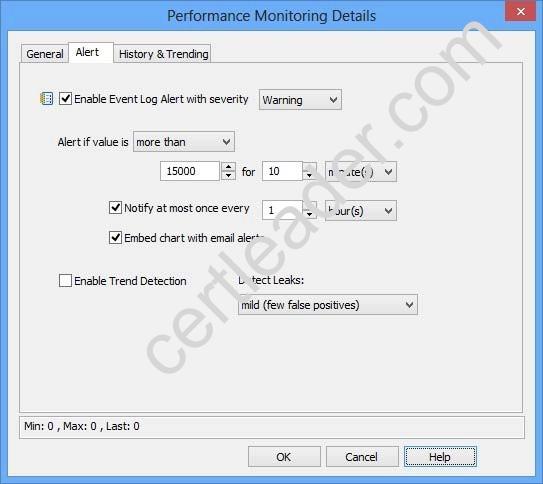
NEW QUESTION 6
HOTSPOT
Your network contains an Active Directory domain named contoso.com. The domain contains the users shown in the following table.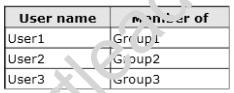
You have a Network Policy Server (NPS) server that has the network policies shown in the following table.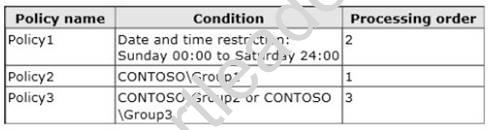
User1, User2, and User3 plan to connect to the network by using a VPN. You need to identify which network policy will apply to each user.
What should you identify?
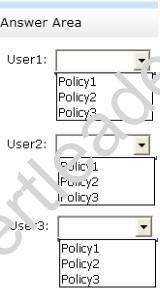
To answer, select the appropriate policy for each user in the answer area.
Answer:
Explanation: When you configure multiple network policies in NPS, the policies are an ordered list of rules. NPS evaluates the policies in listed order from first to last. If there is a network policy that matches the connection request, NPS uses the policy to determine whether to grant or deny access to the user or computer connection.
Network policies are evaulated according to the processing order. Once a match is found, no further network policy is processed.
Policies are processed in this order:
-Policy2 (applies only to members of Group1)
-Policy1 (applies to all users during specified time slot)
-Policy3 (applies only to members of Group2)
Since policy1 will always apply (sunday 0:00 to saturday 24:00 = always), policy3 will never be evaluated.
Correct answer is : User1: Policy2 User2: Policy1 User3: Policy1
https://technet.microsoft.com/en-us/library/cc732724(v=ws.10).aspx
NEW QUESTION 7
Your network has a router named Router1 that provides access to the Internet. You have a server named Server1 that runs Windows Server 2012 R2. Server1 to use Router1 as the default gateway.
A new router named Router2 is added to the network. Router2 provides access to the Internet. The IP address of the internal interface on Router2 is 10.1.14.2S4.
You need to configure Server1 to use Router2 to connect to the Internet if Router1 fails. What should you do on Server1?
- A. Add a route for 10.1.14.0/24 that uses 10.1.14.254 as the gateway and set the metric to 1.
- B. Add 10.1.14.254 as a gateway and set the metric to 1.
- C. Add a route for 10.1.14.0/24 that uses 10.1.14.254 as the gateway and set the metric to 500.
- D. Add 10.1.14.254 as a gateway and set the metric to 500.
Answer: C
Explanation: To configure the Automatic Metric feature:
1. In Control Panel, double-click Network Connections.
2. Right-click a network interface, and then click Properties.
3. Click Internet Protocol (TCP/IP), and then click Properties.
4. On the General tab, click Advanced.
5. To specify a metric, on the IP Settings tab, click to clear the Automatic metric check box, and then enter the metric that you want in the Interface Metric field.
To manually add routes for IPv4
Open the Command Prompt window by clicking the Start button Picture of the Start button. In the search box, type Command Prompt, and then, in the list of results, click Command Prompt.
At the command prompt, type route -p add [destination] [mask <netmask>] [gateway] [metric <metric>] [if <interface>].
NEW QUESTION 8
HOTSPOT
Your network contains an Active Directory domain named contoso.com. The domain contains a server named Server1 that runs Windows Server 2012 R2 and has the Network Policy Server role service installed.
An administrator creates a Network Policy Server (NPS) network policy named Policy1. You need to ensure that Policy1 applies to L2TP connections only.
Which condition should you modify?
To answer, select the appropriate object in the answer area.
Answer:
Explanation: 
NEW QUESTION 9
DRAG DROP
Your network contains an Active Directory domain named contoso.com. All domain controllers run Windows Server 2012 R2.
The domain contains an organizational unit (OU) named OU1. OU1 contains an OU named OU2. OU2 contains a user named user1.
User1 is the member of a group named Group1. Group1 is in the Users container.
You create five Group Policy objects (GPO). The GPOs are configured as shown in the
following table.
The Authenticated Users group is assigned the default permissions to all of the GPOs. There are no site-level GPOs.
You need to identify which three GPOs will be applied to User1 and in which order the GPOs will be applied to User1.
Which three GPOs should you identify in sequence? To answer, move the appropriate three GPOs from the list of GPOs to the answer area and arrange them in the correct order.
Answer:
Explanation: Box 1: GPO2
Box 2: GPO4
Box 3: GPO5
Note:
* First at the domain level (GPO2), then at the highest OU level GPO4, and finally at the OU level containing user1 GPO5.
Incorrect:
* Read and Apply group policy are both needed in order for the user or computer to receive and process the policy
Not GPO1: Group1 has Deny Apply Group Policy permissions on GPO1. Not GPO3: Group1 has Deny Read permissions on GPO3.
GPO2 and GPO4 are disabled.
* When a Group Policy Object (GPO) is enforced it means the settings in the Group Policy Object on an Organization Unit (which is shown as a folder within the Active Directory Users and Computers MMC) cannot be overruled by a Group Policy Object (GPO) which is link enabled on an Organizational Unit below the Organizational Unit with the enforced Group Policy Object (GPO).
* Group Policy settings are processed in the following order: 1 Local Group Policy object
2 Site.
3 Domain
4 Organizational units
GPOs that are linked to the organizational unit that is highest in the Active Directory hierarchy are processed first, then GPOs that are linked to its child organizational unit, and so on. Finally, the GPOs that are linked to the organizational unit that contains the user or computer are processed.
NEW QUESTION 10
Your network contains an Active Directory domain named contoso.com. All domain controllers run Windows Server 2012 R2.
DirectAccess is deployed to the network.
Remote users connect to the DirectAccess server by using a variety of network speeds.
The remote users report that sometimes their connection is very slow.
You need to minimize Group Policy processing across all wireless wide area network (WWAN) connections.
Which Group Policy setting should you configure?
- A. Configure Group Policy slow link detection.
- B. Configure Direct Access connections as a fast network connection.
- C. Configure wireless policy processing.
- D. Change Group Policy processing to run asynchronously when a slow network connection is detected.
Answer: A
NEW QUESTION 11
HOTSPOT
Your network contains an Active Directory domain named contoso.com. The domain
contains a server named Print1.
Your company implements DirectAccess.
A user named User1 frequently works at a customer's office. The customer's office contains a print server named Print1.
While working at the customer's office, User1 attempts to connect to Print1. User1 connects to the Print1 server in contoso.com instead of the Print1 server at the customer's office.
You need to provide User1 with the ability to connect to the Print1 server in the customer's office.
Which Group Policy option should you configure?
To answer, select the appropriate option in the answer area.
Answer:
Explanation: 
NEW QUESTION 12
HOTSPOT
You have a server named Server1 that runs Windows Server 2012 R2. Server1 has the Remote Access server role installed.
You have a client named Client1 that is configured as an 802. IX supplicant.
You need to configure Server1 to handle authentication requests from Client1. The solution must minimize the number of authentication methods enabled on Server1.
Which authentication method should you enable? To answer, select the appropriate authentication method in the answer area.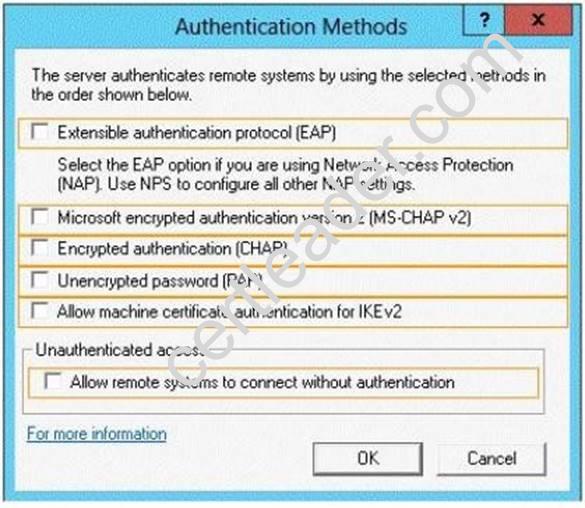
Answer:
Explanation: Microsoft® Windows® uses EAP to authenticate network access for Point-to-Point Protocol (PPP) connections (dial-up and virtual private network) and for IEEE 802.1X-based network access to authenticating Ethernet switches and wireless access points (APs).
NEW QUESTION 13
HOTSPOT
Your network contains one Active directory forest named contoso.com. The forest contains
a single domain. All domain controllers are virtual machines that run Windows Server 2012 R2. The functional level of the domain and the forest is Windows Server 2012 R2.
The forest contains the domain controllers configured as shown in the following table.
In the table below, select the domain controller that can be cloned by using domain controller cloning and select the domain controller that must be online to perform domain controller cloning.
NOTE: Make only one selection in each column.
Answer:
Explanation: References:
http://blogs.technet.com/b/canitpro/archive/2013/06/12/step-by-step-domain-controller- cloning.aspx
PDC Emulator must be online to perform Domain Controller Cloning. The following server roles are not supported for cloning:
Dynamic Host Configuration Protocol (DHCP) Active Directory Certificate Services (AD CS)
Active Directory Lightweight Directory Services (AD LDS) https://technet.microsoft.com/en-us/library/hh831734.aspx#virtualized_dc_cloning
http://blogs.technet.com/b/canitpro/archive/2013/06/12/step-by-step-domain-controller- cloning.aspx
NEW QUESTION 14
Your network contains an Active Directory domain named contoso.com. All domain controllers run Windows Server 2012 R2.
An organizational unit (OU) named OU1 contains 200 client computers that run Windows 8 Enterprise. A Group Policy object (GPO) named GPO1 is linked to OU1.
You make a change to GPO1.
You need to force all of the computers in OU1 to refresh their Group Policy settings immediately. The solution must minimize administrative effort.
Which tool should you use?
- A. The Secedit command
- B. Group Policy Management Console (GPMC)
- C. Server Manager
- D. The Gpupdate command
Answer: B
Explanation: In the previous versions of Windows, this was accomplished by having the user run GPUpdate.exe on their computer.
Starting with Windows Server® 2012 and Windows® 8, you can now remotely refresh Group Policy settings for all computers in an OU from one central location through the Group Policy Management Console (GPMC). Or you can use the Invoke-GPUpdatecmdlet to refresh Group Policy for a set of computers, not limited to the OU structure, for example, if the computers are located in the default computers container.


http: //technet. microsoft. com/en-us//library/jj134201. aspx
http://blogs.technet.com/b/grouppolicy/archive/2012/11/27/group-policy-in-windows-server-2012-using-remote-gpupdate. aspx
NEW QUESTION 15
DRAG DROP
Your network contains a production Active Directory forest named contoso.com and a test Active Directory forest named test.contoso.com. There is no network connectivity between contoso.com and test.contoso.com.
The test.contoso.com domain contains a Group Policy object (GPO) named GPO1. You need to apply the settings in GPO1 to the contoso.com domain.
Which four actions should you perform?
To answer, move the four appropriate actions from the list of actions to the answer area and arrange them in the correct order.
Answer:
Explanation: 
NEW QUESTION 16
Your network contains an Active Directory domain named contoso.com. The functional level of the forest is Windows Server 2008 R2.
Computer accounts for the marketing department are in an organizational unit (OU) named DepartmentsMarketingComputers. User accounts for the marketing department are in an OU named DepartmentsMarketingUsers.
All of the marketing user accounts are members of a global security group named MarketingUsers. All of the marketing computer accounts are members of a global security group named MarketingComputers.
In the domain, you have Group Policy objects (GPOs) as shown in the exhibit. (Click the Exhibit button.)
You create two Password Settings objects named PSO1 and PSO2. PSO1 is applied to MarketingUsers. PSO2 is applied to MarketingComputers.
The minimum password length is defined for each policy as shown in the following table.
You need to identify the minimum password length required for each marketing user.
What should you identify?
- A. 5
- B. 6
- C. 7
- D. 10
- E. 12
Answer: D
NEW QUESTION 17
HOTSPOT
You have a server named Server1 that has the Web Server (IIS) server role installed. You obtain a Web Server certificate.
You need to configure a website on Server1 to use Secure Sockets Layer (SSL).
To which store should you import the certificate? To answer, select the appropriate store in the answer area.
Answer:
Explanation: http: //technet.microsoft.com/en-us/library/cc740068(v=ws.10).aspx
When you enable secure communications (SSL and TLS) on an Internet Information Services (IIS) computer, you must first obtain a server certificate.
If it is a Self-Signed certificate, it only can be used on the local server machine.
If it is a public certificate, you'll need to download the CA root certificate of the certificate and install the CA root certificate into the Trusted Root Certificate Authorities store.
Root certificates provide a level of trust that certificates that are lower in the hierarchy can inherit. Each certificate is inspected for a parent certificate until the search reaches the root
certificate.
For more information about certificate, please refer to: References:
http: //technet.microsoft.com/en-us/library/cc700805.aspx http: //support.microsoft.com/kb/232137/en-us
http: //www.sqlservermart.com/HowTo/Windows_Import_Certificate.aspx
http: //msdn.microsoft.com/en-us/library/windows/hardware/ff553506%28v=vs.85%29.aspx
http: //www.iis.net/learn/manage/configuring-security/how-to-set-up-ssl-on-iis
http: //support.microsoft.com/kb/299875/en-us
http: //technet.microsoft.com/en-us/library/dd163531.aspx
http://blogs.msdn.com/b/mosharaf/archive/2006/10/30/using-test-certificate-with-reporting-services-2005-to-establish-ssl-connection.aspx
NEW QUESTION 18
Your network contains an Active Directory domain named contoso.com. The domain contains two member servers named Server1 and Server2. All servers run Windows Server
2012 R2.
Server1 and Server2 are nodes in a Hyper-V cluster named Cluster1. Cluster1 hosts 10 virtual machines. All of the virtual machines run Windows Server 2012 R2 and are members of the domain.
You need to ensure that the first time a service named Service1 fails on a virtual machine, the virtual machine is moved to a different node.
You configure Service1 to be monitored from Failover Cluster Manager. What should you configure on the virtual machine?
- A. From the General settings, modify the Startup type.
- B. From the General settings, modify the Service status.
- C. From the Recovery settings of Service1, set the First failure recovery action to Take No Action.
- D. From the Recovery settings of Service1, set the First failure recovery action to Restart the Service.
Answer: C
Explanation: Configure the virtual machine to take no action through Hyper-V if the physical computer shuts down by modifying the Automatic Stop Action setting to None. Virtual machine state must be managed through the Failover Clustering feature.
Virtual machine application monitoring and management
In clusters running Windows Server 2012, administrators can monitor services on clustered virtual machines that are also running Windows Server 2012. This functionality extends the high-level monitoring of virtual machines that is implemented in Windows Server 2008 R2 failover clusters. If a monitored service in a virtual machine fails, the service can be restarted, or the clustered virtual machine can be restarted or moved to another node (depending on service restart settings and cluster failover settings).
This feature increases the uptime of high availability services that are running on virtual machines within a failover cluster.
Windows Server 2012 Failover Cluster introduces a new capability for Hyper-V virtual machines (VMs), which is a basic monitoring of a service within the VM which causes the VM to be rebooted should the monitored service fail three times. For this feature to work the following must be configured:
✑ Both the Hyper-V servers must be Windows Server 2012 and the guest OS running in the VM must be Windows Server 2012.
✑ The host and guest OSs are in the same or at least trusting domains.
✑ The Failover Cluster administrator must be a member of the local administrator's group inside the VM.
Ensure the service being monitored is set to Take No Action (see screen shot below) within the guest VM for Subsequent failures (which is used after the first and second failures) and is set via the Recovery tab of the service properties within the Services application (services. msc).
Within the guest VM, ensure the Virtual Machine Monitoring firewall exception is enabled for the Domain network by using the Windows Firewall with Advanced Security application or by using the Windows PowerShell command below: Set-NetFirewallRule -DisplayGroup "Virtual Machine Monitoring" -Enabled True.
After the above is true, enabling the monitoring is a simple process:
✑ Launch the Failover Cluster Manager tool.
✑ Navigate to the cluster - Roles.
✑ Right click on the virtual machine role you wish to enable monitoring for and under More Actions select Configure Monitoring.
✑ The services running inside the VM will be gathered and check the box for the services that should be monitored and click OK.
You are done!
Monitoring can also be enabled using the Add-ClusterVMMonitoredItemcmdlet and - VirtualMachine, with the -Service parameters, as the example below shows: PS C:Windowssystem32> Add-ClusterVMMonitoredItem -VirtualMachine savdaltst01 - Service spooler
References:
http: //sportstoday. us/technology/windows-server-2012---continuous-availability-%28part- 4%29---failover-clustering-enhancements---virtual-machine-monitoring-. aspx
http: //windowsitpro. com/windows-server-2012/enable-windows-server-2012-failover- cluster-hyper-v-vm-monitoring
http: //technet. microsoft. com/en-us/library/cc742396. aspx
NEW QUESTION 19
Note: This question is part of a series of questions that use the same or similar answer choices. An answer choice may be correct for more than one question in the series. Each question is independent of the other questions in this series. Information and details provided in a question apply only to that question.
Your network contains an Active Directory domain named contoso.com. The domain contains more than 100 Group Policy objects (GPOs). Currently, there are no enforced GPOs.
You have a GPO named GPO1 that is linked to the domain. You need to configure GPO1 to apply settings to Group1 only. You need to configure GPO1 to apply settings to Group1 only. What should you use?
- A. Dcgpofix
- B. Get-GPOReport
- C. Gpfixup
- D. Gpresult
- E. Gpedi
- F. msc
- G. Import-GPO
- H. Restore-GPO
- I. Set-GPInheritance
- J. Set-GPLink
- K. Set-GPPermission
- L. Gpupdate
- M. Add-ADGroupMember
Answer: C
NEW QUESTION 20
Your company has a main office and a branch office.
The network contains an Active Directory domain named contoso.com.
The main office contains a domain controller named DC1 that runs Windows Server 2012 R2. DC1 is a DNS server and hosts a primary zone for contoso.com. The branch office contains a member server named Server1 that runs Windows Server 2012 R2. Server1 is a DNS server and hosts a secondary zone for contoso.com.
The main office connects to the branch office by using an unreliable WAN link.
You need to ensure that Server1 can resolve names in contoso.com if the WAN link in unavailable for three days.
Which setting should you modify in the start of authority (SOA) record?
- A. Retry interval
- B. Refresh interval
- C. Expires after
- D. Minimum (default) TTL
Answer: C
Explanation: Used by other DNS servers that are configured to load and host the zone to determine when zone data expires if it is not renewed
Thanks for reading the newest 70-411 exam dumps! We recommend you to try the PREMIUM Surepassexam 70-411 dumps in VCE and PDF here: https://www.surepassexam.com/70-411-exam-dumps.html (294 Q&As Dumps)