VMware 2V0-622D Exam Dumps 2021
Proper study guides for 2V0-622D VMware Certified Professional 6.5 – Data Center Virtualization Delta Exam certified begins with preparation products which designed to deliver the by making you pass the 2V0-622D test at your first time. Try the free right now.
Online 2V0-622D free questions and answers of New Version:
NEW QUESTION 1
When installing vCenter Converter Standalone, why must an administrator perform a client-server installation instead of a local installation?
- A. to manage conversion tasks remotely
- B. to convert virtual machines as well as physical machines
- C. to allow installation of the Converter agent on remote source machines
- D. to hot clone physical or virtual machines
Answer: A
NEW QUESTION 2
When using “Cluster resource percentage” for host failover capacity in vSphere HA Admission Control, the total resource requirements are calculated from which two values? (Choose two.)
- A. Total vCPUs assigned to each VM.
- B. Average CPU usage on each VM over time.
- C. Memory reservations on each VM.
- D. Total memory assigned to each VM.
- E. Average active memory on each VM over time.
- F. CPU reservations on each VM.
Answer: CF
NEW QUESTION 3
The vSphere HA agent has been in the "Agent Unreachable" state on a single slave ESXi host for over a minute. The master and slave ESXi hosts are connected to the vCenter Server Appliance.
Which should be the first step for validation the network configuration?
- A. Log into the affected slave ESXi host via console or SSH and attempt to ping the master ESXi host over the vSphere HA network.
- B. Log into the master ESXi host via console or SSH and attempt to ping the vCenter Server Appliance over the vSphere HA network.
- C. Log into the affected slave ESXi host via console or SSH and attempt to ping the vCenter Server Appliance over the Fault Tolerance network.
- D. Log into the vCenter Server Appliance via console or SSH and attempt to ping the affected slave ESXi host.
Answer: D
NEW QUESTION 4
Which two types of iSCSI adapters require VMkernel networking configuration? (Choose two.)
- A. software
- B. in-guest
- C. independent hardware
- D. dependent hardware
Answer: AD
NEW QUESTION 5
Boot from SAN is supported on which three storage technologies? (Choose three.)
- A. iSCSI
- B. NFS 4.1
- C. FC
- D. VMware vSAN
- E. FCoE
Answer: ACE
NEW QUESTION 6
Option available to enable Encrypted vMotion. (Choose two.)
- A. Enable
- B. Opportunistic
- C. Required
- D. Default
Answer: BC
NEW QUESTION 7
An administrator is trying to add a new virtual disk of 3TB to a virtual machine on a recently upgraded ESXi
6.x host, but receives this error:
The disk capacity entered was not a properly formed number or was out of range. It has been replaced with the nearest acceptable value.
How can the new virtual disk be added to the virtual machine?
- A. Upgrade the VMFS datastore.
- B. Change the VMFS datastore block size to 8MB.
- C. Move the virtual machine to a datastore with free space.
- D. Use vmkfstools to upgrade to VMFS6.
Answer: B
NEW QUESTION 8
When will vSphere Data Protection delete the expired backup image of a Platform Service Controller?
- A. After the expired backup image is restored.
- B. During the next backup window following expiry.
- C. During the next maintenance window following expiry.
- D. Immediately after the retention period has expired.
Answer: D
Explanation: https://docs.vmware.com/en/VMware-vSphere/6.0/vmware-data-protection-administration-guide-60.pdf ‘During maintenance periods, VDP examines the backups in the appliance and evaluates whether the
backupretention period has expired. If ithas expired, VDP removes the expired backup from the appliance.’
NEW QUESTION 9
Which three operations can cause VMFS metadata updates? (Choose three.)
- A. Restarting a VM using the guest OS.
- B. Launching a VM console.
- C. Migrating a VM with vMotion.
- D. Powering a VM on or off.
- E. Expanding a VMFS datastore.
Answer: CDE
Explanation: Metadata is updated each time you perform datastore or virtual machine management operations. Examples of operations requiring metadata updates include the
following:
Creating, growing, or locking a virtual machine file Changing a file's attributes
Powering a virtual machine on or off Creating or deleting a VMFS datastore Expanding a VMFS datastore
Creating a template
Deploying a virtual machine from a template Migrating a virtual machine with vMotion Reference:
https://pubs.vmware.com/vsphere-50/index.jsp?topic=%2Fcom.vmware.vsphere.storage.doc_50%2FGUID-7A3 51E26A4761AA.html
NEW QUESTION 10
What VM Monitoring setting would ensure that the failure interval for a virtual machine is defined as 120 seconds?
- A. High
- B. Medium
- C. Low
- D. Normal
Answer: C
Explanation: 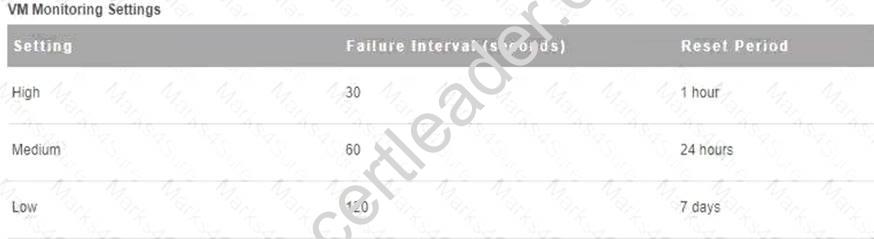
NEW QUESTION 11
An administrator wants to enable proactive HA by moving virtual machines automatically if a hardware alert is triggered.
What are the three requires settings? (Choose three.)
- A. Turn on vSphere HA and vSphere DRS.
- B. Set the Proactive HA Automation Level to Manual.
- C. Set vSphere DRS Automation to Partially Automated.
- D. Turn on Proactive HA.
- E. Set the Proactive HA Automation Level to Automated.
Answer: ACD
NEW QUESTION 12
Which metric in the Exhibit would identify high latency for a storage device?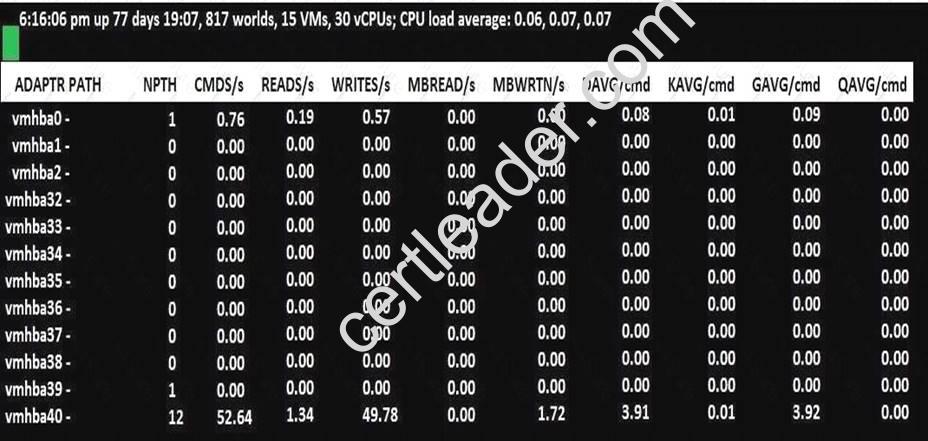
- A. KAVG/cmd
- B. DAVG/cmd
- C. GAVG/cmd
- D. QAVG/cmd
Answer: B
Explanation: 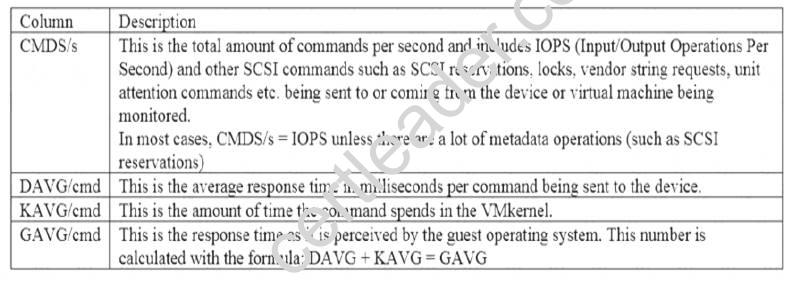
NEW QUESTION 13
An administrator wants to enable VMware Fault Tolerance on a virtual machine.
Which two vSphere features are supported with Fault Tolerance? (Choose two.)
- A. VM Component Protection
- B. vSphere HA
- C. Storage DRS
- D. Snapshots
Answer: BC
NEW QUESTION 14
Which is the correct order for upgrading vSphere components?
- A. vCenter Server, ESXi hosts, VMware Tools, Virtual Machine hardware
- B. VMware Tools, Virtual Machine hardware, ESXi hosts, vCenter Server
- C. vCenter Server, Virtual Machine hardware, VMware tools, ESXi hosts
- D. ESXi hosts, vCenter Server, Virtual Machine hardware, VMware Tools
Answer: A
Explanation: Correct order is:
1 Back up your configuration 2 Upgrade vCenter Server
3 Upgrade ESXi hosts
4 Upgrade virtual machines and virtual appliances
NEW QUESTION 15
What are two requirements to enable EVC in a vSphere DRS cluster? (Choose two.)
- A. CPUs must be from the same vendor.
- B. CPUs must be in the same family and of the same speed.
- C. No VMs may be running in the cluster.
- D. EVC must use the lowest possible baseline supported by the hardware.
Answer: AD
NEW QUESTION 16
Which is the correct sequence to upgrade a vSphere infrastructure?
- A. vCenter Server > ESXi host > VMware Tools > VM compatibility
- B. vCenter Server > ESXi host > VM compatibility > VMware Tools
- C. ESXi host > vCenter Server > VMware Tools > VM compatibility
- D. ESXi host > vCenter Server > VM compatibility > VMware Tools
Answer: A
100% Valid and Newest Version 2V0-622D Questions & Answers shared by 2passeasy, Get Full Dumps HERE: https://www.2passeasy.com/dumps/2V0-622D/ (New 269 Q&As)