VMware 2V0-622D Dumps 2021
Act now and download your today! Do not waste time for the worthless tutorials. Download with real questions and answers and begin to learn with a classic professional.
Online 2V0-622D free questions and answers of New Version:
NEW QUESTION 1
Which feature of vSphere networking protects hosts from losing connection to vCenter Server as a result of misconfiguration of the management network?
- A. NIC Teaming
- B. Private VLAN
- C. Rollback
- D. Health Check
Answer: C
Explanation: By rolling configuration changes back, vSphere protects hosts from losing connection to vCenter Server as a result from misconfiguration of the management network.
NEW QUESTION 2
What new feature was introduced to the Content Library in vSphere 6.5?
- A. Mount an ISO directly from the Content Library.
- B. Deploy a virtual machine from an OVF Package in a Content Library.
- C. Upload a File from a URL to a Library Item.
- D. Upload a File from a Local System to a Library Item.
Answer: A
Explanation: Content Libraries in vSphere 6.5, which has additional features including the option to mount an ISO from a Content Library, update existing templates, and apply guest OS Customisation Specifications during VM deployments.
https://esxsi.com/2021/12/30/content-libraries/
NEW QUESTION 3
What VM Monitoring setting would ensure that the maximum reset window for a virtual machine is 24 hours?
- A. Normal
- B. Low
- C. High
- D. Medium
Answer: D
Explanation: https://blogs.vmware.com/vsphere/2014/03/vsphere-ha-vm-monitoring-back-basics.html
NEW QUESTION 4
A vSphere Administrator is in the process of configuring replication for a virtual machine, but is not able to select the Recovery Point Objective (RPO) value of 5 minute.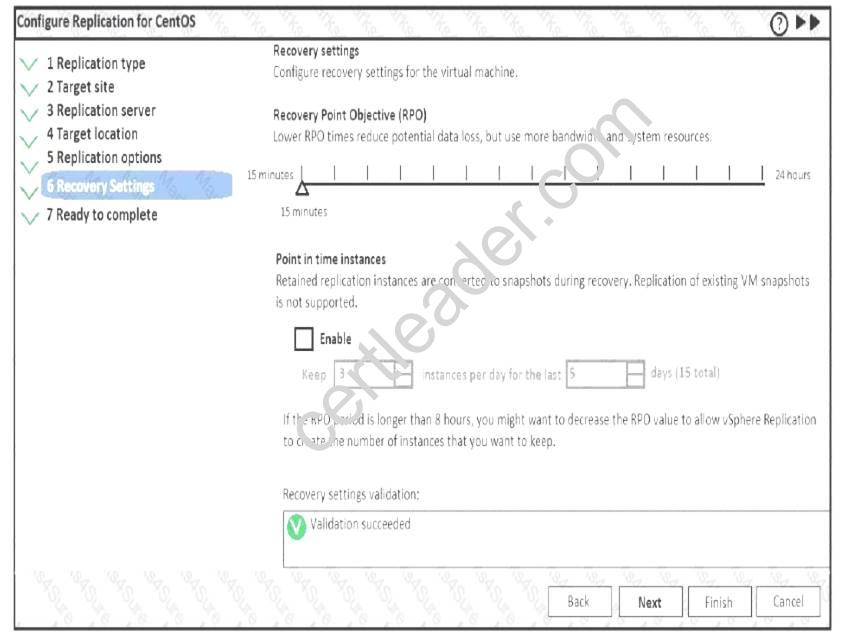
Which statement could explain why the RPO value cannot be lower than 15 minutes?
- A. The target and source sites use different types of datastores.
- B. The OS quiescing option is selected for Replication options.
- C. The virtual machine hardware version is not compatible.
- D. The target and source sites are not using VMFS 6.0 datastore.
Answer: B
NEW QUESTION 5
In network troubleshooting it is important to know what upstream switch the ESXi host is connected to. Which two features does ESXi provide to help identify the upstream switch? (Choose two.)
- A. DPM
- B. Promiscuous mode
- C. LLDP
- D. CDP
Answer: CD
NEW QUESTION 6
On which level is the virtual machine system traffic reservation defined in Network I/O Control version 3?
- A. Uplink
- B. Distributed switch
- C. Distributed portgroup
- D. Host
Answer: B
NEW QUESTION 7
When upgrading a standalone vCenter Single Sign-On Server version 5.5 to version 6.5, which will be the final deployment type?
- A. There is no option to do this type of upgrade.
- B. It will be an external Platform Services Controller.
- C. It will be an embedded Platform Services Controller with vCenter Server
- D. It will be a Standalone vCenter Server.
Answer: B
Explanation:
You can upgrade an externally deployed vCenter Single Sign-On 5.5 to an externally deployed Platform Services Controller 6.5 instance by using the vCenter Server for Windows installer.
NEW QUESTION 8
When enabling Storage DRS on a datastore cluster, which three components are enabled as a result? (Choose three.)
- A. Space load balancing among datastore within the datastore cluster.
- B. Initial placement for virtual disks based on space and I/O workload.
- C. I/O load balancing among datastores within the datastore cluster.
- D. Queue Depth alerting on disks within the datastore cluster.
- E. Data de-duplication within the datastore cluster.
Answer: ABC
Explanation: When you enable Storage DRS, you enable the following functions:
NEW QUESTION 9
When working with VM-VM DRS rules (affinity/anti-affinity), which statement is correct?
- A. DRS gives higher priority to preventing violations of affinity rules than violations of anti-affinity rules.
- B. DRS gives the same priority to preventing violations of anti-affinity rules as affinity rules.
- C. DRS does not allow both affinity and anti-affinity rules to be enabled at the same time within a cluster.
- D. DRS gives higher priority to preventing violations of anti-affinity rules than violations of affinity rules.
Answer: A
Explanation: When two VM-VM affinity rules conflict, the older one takes precedence and the newer rule is disabled. DRS only tries to satisfy enabled rules and disabled rules are ignored. DRS gives higher precedence to preventing violations of anti-affinity rules than violations of affinity rules.
NEW QUESTION 10
Two sibling resource pools named RP-CHILD-A and RP-CHILD-B have these configurations:
• RP-CHILD-A has an expandable reservation and memory shares set to ‘2000’ with 10 VMs, each with 4GB of RAM
• RP-CHILD-B has an expandable reservation and memory shares set to ‘4000’ with 30 VMs, each with 4GB of RAM
Which statement is true during times of memory contention?
- A. VMs in RP-CHILD-B will have the same number of shares as in RP-CHILD-A
- B. VMs in RP-CHILD-A will not use shares to allocate resources
- C. As long as no additional VMs are added to either resource pool, VMs in RP-CHILD-A will ALWAYS have more shares per VM than RP-CHILD-B
- D. As long as no additional VMs are added to either resource pool, VMs in RP-CHILD-B will ALWAYS have more shares per VM than RP-CHILD-A
Answer: C
NEW QUESTION 11
An administrator finds that the Microsoft Exchange virtual machines are exhibiting network latency. What two in-guest changes can help decrease latency? (Choose two.)
- A. PVDRMA
- B. TSO
- C. SR-IOV
- D. LRO
Answer: BD
Explanation: Using TSO and LRO on physical and virtual machine NICs improves the performance of ESX/ESXi hosts by reducing the CPU overhead for TCP/IP network operations. The host uses more CPU cycles to run applications.
If TSO is enabled on the transmission path, the NIC divides larger data chunks into TCP segments. If TSO is disabled, the CPU performs segmentation for TCP/IP.
TSO is referred to as LSO (Large Segment Offload or Large Send Offload) in the latest VMXNET3 driver
attributes.
LRO reassembles incoming network packets into larger buffers and transfers the resulting larger but fewer packets to the network stack of the host or virtual machine. The CPU has to process fewer packets than when LRO is disabled, which reduces its utilization for networking.
NEW QUESTION 12
The administrator wants to power on VM-K2, which has a 2GHz CPU reservation. VM-M1, VM-M2, and VM-K1 are all powered on. VM-K2 is not powered on.
The exhibit shows the parent and child resource reservations.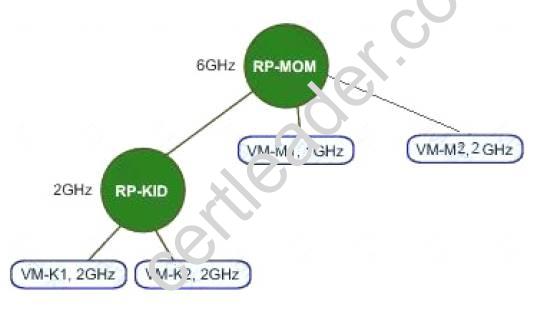
If Resource Pool RP-KID is configured with an expandable reservation, which statement is true?
- A. VM-K2 will be unable to power on because there are insufficient resources.
- B. VM-K2 will be able to power on since resource pool RP-KID has 2GHz available.
- C. VM-K2 will be unable to power on because only 2GHz are reserved for RP-KID.
- D. VM-K2 will receive resource priority and will be able to power on this scenario.
Answer: A
NEW QUESTION 13
Which three VMware-recommended best practices should an administrator follow before upgrading to vSphere 6.5? (Choose three.)
- A. Disconnect ESXi host from vCenter.
- B. VMware Tools are installed in the virtual machine.
- C. Ensure that the system hardware complies with ESXi requirements.
- D. Back up the host.
- E. Check the interoperability of any other software integrated with vSphere.
Answer: CDE
NEW QUESTION 14
Which setting will allow a virtual machine to have direct secure access to an RDM?
- A. NIOC
- B. NPV
- C. NPIV
- D. CPUID Mask
Answer: C
NEW QUESTION 15
How can failback of a recovered virtual machine in vSphere Replication be performed?
- A. No action required, because failback is automatically performed to the source site.
- B. Configure a new replication in the reverse machine at the target site.
- C. Power off and unregister the virtual machine on the target site.
- D. Disable or Stop the virtual machine replication on the source site.
Answer: B
Explanation: Failback of Virtual Machines in vSphere Replication
Failback of virtual machines is a manual task in a vSphere Replication.
After performing a successful recovery from the primary site to the secondary site, you can perform failback. You manually configure a new replication in the reverse direction, that is, from the secondary site to the primary site. The disks of the primary site are used as replication seeds, so that vSphere Replication only synchronizes the changes made to the .vmdk files. Before you configure the reverse replication, you must manually unregister the virtual machine from the inventory on the primary site.
NEW QUESTION 16
An administrator is trying to remove a host from a vSphere Distributed Switch named DSwitch01. The following error message is displayed:
vDS DSwitch01 port 17 is still on host 192.168.100.23 connected to VM01 nic=4000 type=vmVnic
Which two actions can the administrator make before removing the host from the vSphere Distributed Switch? (Choose two.)
- A. Migrate VM01 to DSwitch01 port 1.
- B. Add an additional vNIC to VM01 to another vSphere Distributed Switch.
- C. Migrate VM01 to another host.
- D. Disconnect the VM01’s vNIC.
- E. Place VM01 into Maintenance Mode.
Answer: CD
Explanation: Before removing the host from distributed switch, migrate VM01 to Dswitch01 Port1. Then disconnect VM01 NIC.
P.S. Easily pass 2V0-622D Exam with 269 Q&As Certleader Dumps & pdf Version, Welcome to Download the Newest Certleader 2V0-622D Dumps: https://www.certleader.com/2V0-622D-dumps.html (269 New Questions)