Leading CAS-003 Q&A 2021
Your success in CompTIA CAS-003 is our sole target and we develop all our CAS-003 braindumps in a way that facilitates the attainment of this target. Not only is our CAS-003 study material the best you can find, it is also the most detailed and the most updated. CAS-003 Practice Exams for CompTIA CompTIA Other Exam CAS-003 are written to the highest standards of technical accuracy.
CompTIA CAS-003 Free Dumps Questions Online, Read and Test Now.
NEW QUESTION 1
The Chief Information Officer (CIO) has been asked to develop a security dashboard with the relevant metrics. The board of directors will use the dashboard to monitor and track the overall security posture of the organization. The CIO produces a basic report containing both KPI and KRI data in two separate sections for the board to review.
Which of the following BEST meets the needs of the board?
- A. KRI:- Compliance with regulations- Backlog of unresolved security investigations- Severity ofthreats and vulnerabilities reported by sensors- Time to patch critical issues on a monthly basisKPI:- Time to resolve open security items- % of suppliers with approved security control frameworks- EDR coverage across the fileet- Threat landscape rating
- B. KRI:- EDR coverage across the fileet- Backlog of unresolved security investigations- Time to patch critical issues on a monthly basis- Threat landscape ratingKPI:- Time to resolve open security items- Compliance with regulations- % of suppliers with approved security control frameworks- Severity of threats and vulnerabilities reported by sensors
- C. KRI:- EDR coverage across the fileet- % of suppliers with approved security control framework- Backlog of unresolved security investigations- Threat landscape ratingKPI:- Time to resolve open security items- Compliance with regulations- Time to patch critical issues on a monthly basis- Severity of threats and vulnerabilities reported by sensors
- D. KPI:- Compliance with regulations- % of suppliers with approved security control frameworks- Severity of threats and vulnerabilities reported by sensors- Threat landscape ratingKRI:- Time to resolve open security items- Backlog of unresolved security investigations- EDR coverage across the fileet- Time to patch critical issues on a monthly basis
Answer: A
NEW QUESTION 2
A forensics analyst suspects that a breach has occurred. Security logs show the company’s OS patch system may be compromised, and it is serving patches that contain a zero-day explogt and backdoor. The analyst extracts an executable file from a packet capture of communication between a client computer and the patch server. Which of the following should the analyst use to confirm this suspicion?
- A. File size
- B. Digital signature
- C. Checksums
- D. Anti-malware software
- E. Sandboxing
Answer: B
NEW QUESTION 3
The Chief Executive Officer (CEO) of an Internet service provider (ISP) has decided to limit the company’s contribution to worldwide Distributed Denial of Service (DDoS) attacks. Which of the following should the ISP implement? (Select TWO).
- A. Block traffic from the ISP’s networks destined for blacklisted IPs.
- B. Prevent the ISP’s customers from querying DNS servers other than those hosted by the ISP.
- C. Scan the ISP’s customer networks using an up-to-date vulnerability scanner.
- D. Notify customers when services they run are involved in an attack.
- E. Block traffic with an IP source not allocated to customers from exiting the ISP's network.
Answer: DE
Explanation:
Since DDOS attacks can originate from nay different devices and thus makes it harder to defend against, one way to limit the company’s contribution to DDOS attacks is to notify customers about any DDOS attack when they run services that are under attack. The company can also block IP sources that are not allocated to customers from the existing SIP’s network.
Incorrect Answers:
A: Blocking traffic is in essence denial of service and this should not be implemented by the company.
B: Preventing the ISP’s customers from querying/accessing other DNS serves is also a denial of service.
C: Making use of vulnerability scanners does not limit a company’s contribution to the DDOS attacks. References:
Gregg, Michael, and Billy Haines, CASP CompTIA Advanced Security Practitioner Study Guide, John Wiley & Sons, Indianapolis, 2012, p. 286
NEW QUESTION 4
An infrastructure team is at the end of a procurement process and has selected a vendor. As part of the final negotiations, there are a number of outstanding issues, including:
1. Indemnity clauses have identified the maximum liability
2. The data will be hosted and managed outside of the company’s geographical location
The number of users accessing the system will be small, and no sensitive data will be hosted in the solution. As the security consultant on the project, which of the following should the project’s security consultant recommend as the NEXT step?
- A. Develop a security exemption, as it does not meet the security policies
- B. Mitigate the risk by asking the vendor to accept the in-country privacy principles
- C. Require the solution owner to accept the identified risks and consequences
- D. Review the entire procurement process to determine the lessons learned
Answer: C
NEW QUESTION 5
Since the implementation of IPv6 on the company network, the security administrator has been unable to identify the users associated with certain devices utilizing IPv6 addresses, even when the devices are centrally managed.
en1: flags=8863<UP,BROADCAST,SMART,RUNNING,SIMPLEX,MULTICAST> mtu 1500
ether f8:1e:af:ab:10:a3
inet6 fw80::fa1e:dfff:fee6:9d8%en1 prefixlen 64 scopeid 0x5 inet 192.168.1.14 netmask 0xffffff00 broadcast 192.168.1.255 inet6 2001:200:5:922:1035:dfff:fee6:9dfe prefixlen 64 autoconf
inet6 2001:200:5:922:10ab:5e21:aa9a:6393 prefixlen 64 autoconf temporary nd6 options=1<PERFORMNUD>
media: autoselect status: active
Given this output, which of the following protocols is in use by the company and what can the system administrator do to positively map users with IPv6 addresses in the future? (Select TWO).
- A. The devices use EUI-64 format
- B. The routers implement NDP
- C. The network implements 6to4 tunneling
- D. The router IPv6 advertisement has been disabled
- E. The administrator must disable IPv6 tunneling
- F. The administrator must disable the mobile IPv6 router flag
- G. The administrator must disable the IPv6 privacy extensions
- H. The administrator must disable DHCPv6 option code 1
Answer: BG
Explanation:
IPv6 makes use of the Neighbor Discovery Protocol (NDP). Thus if your routers implement NDP you will be able to map users with IPv6 addresses. However to be able to positively map users with IPv6 addresses you will need to disable IPv6 privacy extensions.
Incorrect Answers:
A: Devices making use of the EUI-64 format means that the last 64 bits of IPv6 unicast addresses are used for interface identifiers. This is not shown in the exhibit above.
C: 6to4 tunneling is used to connect IPv6 hosts or networks to each other over an IPv4 backbone. This type of tunneling is not going to ensure positive future mapping of users on the network. Besides 6to4 does not require configured tunnels because it can be implemented in border routers without a great deals of router configuration.
D: The exhibit is not displaying that the router IPv6 has been disabled. The IPv6 Neighbor Discovery's Router Advertisement message contains an 8-bit field reserved for single-bit flags. Several protocols have reserved flags in this field and others are preparing to reserve a sufficient number of flags to exhaust the field.
E: Disabling the tunneling of IPv6 does not ensure positive future IPv6 addressing.
F: The IPv6 router flag is used to maintain reachability information about paths to active neighbors, thus it should not be disabled if you want to ensure positive mapping of users in future.
H: DHCPv6 is a network protocol for configuring IPv6 hosts with IP addresses, IP prefixes and other configuration data that is necessary to function properly in an IPv6 network. This should not be disabled.
References:
Gregg, Michael, and Billy Haines, CASP CompTIA Advanced Security Practitioner Study Guide, John Wiley & Sons, Indianapolis, 2012, pp. 49
http://wwwHYPERLINK "http://www.tcpipguide.com/free/t_IPv6InterfaceIdentifiersandPhysicalAddressMapping- 2.htm".HYPERLINK
"http://www.tcpipguide.com/free/t_IPv6InterfaceIdentifiersandPhysicalAddressMapping- 2.htm"tcpipguide.com/free/t_IPv6InterfaceIdentifiersandPhysicalAddressMapping-2.htm
NEW QUESTION 6
Management is reviewing the results of a recent risk assessment of the organization’s policies and procedures. During the risk assessment it is determined that procedures associated with background checks have not been effectively implemented. In response to this risk, the organization elects to revise policies and procedures related to background checks and use a third-party to perform background checks on all new employees. Which of the following risk management strategies has the organization employed?
- A. Transfer
- B. Mitigate
- C. Accept
- D. Avoid
- E. Reject
Answer: B
NEW QUESTION 7
Company.org has requested a black-box security assessment be performed on key cyber terrain. On area of concern is the company’s SMTP services. The security assessor wants to run reconnaissance before taking any additional action and wishes to determine which SMTP server is Internet-facing. Which of the following commands should the assessor use to determine this information?
- A. dnsrecon –d company.org –t SOA
- B. dig company.org mx
- C. nc –v company.org
- D. whois company.org
Answer: A
NEW QUESTION 8
A systems administrator recently joined an organization and has been asked to perform a security assessment of controls on the organization’s file servers, which contain client data from a number of sensitive systems. The administrator needs to compare documented access requirements to the access implemented within the file system.
Which of the following is MOST likely to be reviewed during the assessment? (Select two.)
- A. Access control list
- B. Security requirements traceability matrix
- C. Data owner matrix
- D. Roles matrix
- E. Data design document
- F. Data access policies
Answer: DF
NEW QUESTION 9
The technology steering committee is struggling with increased requirements stemming from an increase in telecommuting. The organization has not addressed telecommuting in the past. The implementation of a new SSL-VPN and a VOIP phone solution enables personnel to work from remote locations with corporate assets. Which of the following steps must the committee take FIRST to outline senior management’s directives?
- A. Develop an information classification scheme that will properly secure data on corporate systems.
- B. Implement database views and constrained interfaces so remote users will be unable to access PII from personal equipment.
- C. Publish a policy that addresses the security requirements for working remotely with company equipment.
- D. Work with mid-level managers to identify and document the proper procedures for telecommuting.
Answer: C
Explanation:
The question states that “the organization has not addressed telecommuting in the past”. It is therefore unlikely that a company policy exists for telecommuting workers.
There are many types of company policies including Working time, Equality and diversity, Change management, Employment policies, Security policies and Data Protection policies.
In this question, a new method of working has been employed: remote working or telecommuting. Policies should be created to establish company security requirements (and any other requirements) for users working remotely.
Incorrect Answers:
A: The data should already be secure on the corporate systems. If an information classification scheme is used as part of the security, it should already have been created. Remote working does not add the requirement for an information classification scheme.
B: The personnel work from remote locations with corporate assets; their personal computers are not used. Therefore, we do not require database views and constrained interfaces so remote users will be unable to access PII from personal equipment.
D: You should identify and document the proper procedures for telecommuting. However, the security requirements for working remotely with company equipment should be addressed first. Furthermore, you would not necessarily work with mid-level managers to identify and document the proper procedures for telecommuting if the company has a technology steering committee.
NEW QUESTION 10
A security administrator has been asked to select a cryptographic algorithm to meet the criteria of a new application. The application utilizes streaming video that can be viewed both on computers and mobile devices. The application designers have asked that the algorithm support the transport encryption with the lowest possible performance overhead. Which of the following recommendations would BEST meet the needs of the application designers? (Select TWO).
- A. Use AES in Electronic Codebook mode
- B. Use RC4 in Cipher Block Chaining mode
- C. Use RC4 with Fixed IV generation
- D. Use AES with cipher text padding
- E. Use RC4 with a nonce generated IV
- F. Use AES in Counter mode
Answer: EF
Explanation:
In cryptography, an initialization vector (IV) is a fixed-size input to a cryptographic primitive that is typically required to be random or pseudorandom. Randomization is crucial for encryption schemes to achieve semantic security, a property whereby repeated usage of the scheme under the same key does not allow an attacker to infer relationships between segments of the encrypted message.
Some cryptographic primitives require the IV only to be non-repeating, and the required randomness is derived internally. In this case, the IV is commonly called a nonce (number used once), and the primitives are described as stateful as opposed to randomized. This is because the IV need not be explicitly forwarded to a recipient but may be derived from a common state updated at both sender and receiver side. An example of stateful encryption schemes is the counter mode of operation, which uses a sequence number as a nonce.
AES is a block cipher. Counter mode turns a block cipher into a stream cipher. It generates the next keystream block by encrypting successive values of a "counter". The counter can be any function which produces a sequence which is guaranteed not to repeat for a long time, although an actual increment-by-one counter is the simplest and most popular.
Incorrect Answers:
A: AES in Electronic Codebook mode cannot be used to encrypt streaming video. You would need a stream cipher such as RC4 or AES in Counter Mode.
B: RC4 in Cipher Block Chaining mode cannot be used to encrypt streaming video. You would need a stream cipher such as RC4 (not in Cipher Block Chaining mode) or AES in Counter Mode.
C: You cannot use fixed IV generation for RC4 when encrypting streaming video.
D: AES with cipher text padding cannot be used to encrypt streaming video. You would need a stream cipher such as RC4 or AES in Counter Mode.
References: https://en.wikipedia.org/wiki/Initialization_vector
NEW QUESTION 11
To prepare for an upcoming audit, the Chief Information Security Officer (CISO) asks for all 1200 vulnerabilities on production servers to be remediated. The security engineer must determine which vulnerabilities represent real threats that can be explogted so resources can be prioritized to migrate the most dangerous risks. The CISO wants the security engineer to act in the same manner as would an external threat, while using vulnerability scan results to prioritize any actions. Which of the following approaches is described?
- A. Blue team
- B. Red team
- C. Black box
- D. White team
Answer: C
NEW QUESTION 12
DRAG DROP
A security consultant is considering authentication options for a financial institution. The following authentication options are available security mechanism to the appropriate use case. Options may be used once.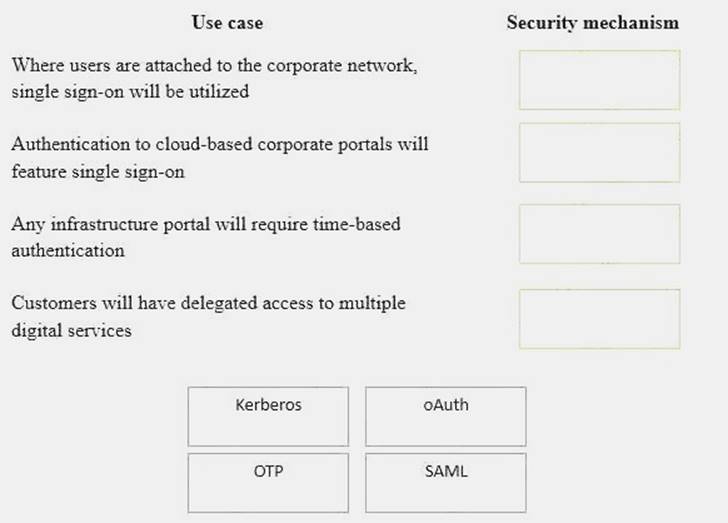
- A. Mastered
- B. Not Mastered
Answer: A
Explanation: 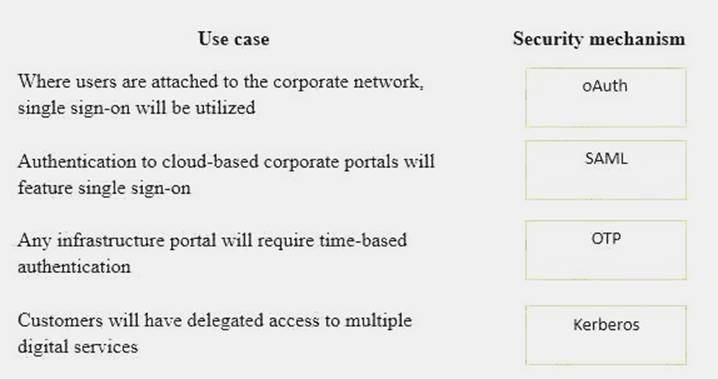
NEW QUESTION 13
A technician receives the following security alert from the firewall's automated system: Match_Time: 10/10/16 16:20:43
Serial: 002301028176
Device_name: COMPSEC1 Type: CORRELATION
Scrusex: domainsamjones Scr: 10.50.50.150
Object_name: beacon detection Object_id: 6005
Category: compromised-host Severity: medium
Evidence: host repeatedly visited a dynamic DNS domain (17 time) After reviewing the alert, which of the following is the BEST analysis?
- A. the alert is a false positive because DNS is a normal network function.
- B. this alert indicates a user was attempting to bypass security measures using dynamic DNS.
- C. this alert was generated by the SIEM because the user attempted too many invalid login attempts.
- D. this alert indicates an endpoint may be infected and is potentially contacting a suspect hos
Answer: B
NEW QUESTION 14
A Chief Information Security Officer (CISO) is reviewing the results of a gap analysis with an outside cybersecurity consultant. The gap analysis reviewed all procedural and technical controls and found the following:
High-impact controls implemented: 6 out of 10 Medium-impact controls implemented: 409 out of 472 Low-impact controls implemented: 97 out of 1000
The report includes a cost-benefit analysis for each control gap. The analysis yielded the following information:
Average high-impact control implementation cost: $15,000; Probable ALE for each high-impact control gap: $95,000
Average medium-impact control implementation cost: $6,250; Probable ALE for each mediumimpact control gap: $11,000
Due to the technical construction and configuration of the corporate enterprise, slightly more than 50% of the medium-impact controls will take two years to fully implement. Which of the following conclusions could the CISO draw from the analysis?
- A. Too much emphasis has been placed on eliminating low-risk vulnerabilities in the past
- B. The enterprise security team has focused exclusively on mitigating high-level risks
- C. Because of the significant ALE for each high-risk vulnerability, efforts should be focused on those controls
- D. The cybersecurity team has balanced residual risk for both high and medium controls
Answer: C
NEW QUESTION 15
A company sales manager received a memo from the company’s financial department which stated that the company would not be putting its software products through the same security testing as previous years to reduce the research and development cost by 20 percent for the upcoming year. The memo also stated that the marketing material and service level agreement for each product would remain unchanged. The sales manager has reviewed the sales goals for the upcoming year and identified an increased target across the software products that will be affected by the financial department’s change. All software products will continue to go through new development in the coming year. Which of the following should the sales manager do to ensure the company stays out of trouble?
- A. Discuss the issue with the software product's user groups
- B. Consult the company’s legal department on practices and law
- C. Contact senior finance management and provide background information
- D. Seek industry outreach for software practices and law
Answer: B
Explanation:
To ensure that the company stays out of trouble, the sales manager should enquire about the legal ramifications of the change by consulting with the company’s legal department, particularly as the marketing material is not being amended.
Incorrect Answers:
A: The software product's user groups would not have insight on the legal ramifications of the change by the company, and they might not have knowledge of the service-level agreements or any contracts that the company has with other customers.
C: The sales manager does not have additional background information to provide.
D: Legal information pertaining to internal operations should be obtained from the company’s legal department.
NEW QUESTION 16
A developer has implemented a piece of client-side JavaScript code to sanitize a user’s provided input to a web page login screen. The code ensures that only the upper case and lower case letters are entered in the username field, and that only a 6-digit PIN is entered in the password field. A security administrator is concerned with the following web server log:
10.235.62.11 – - [02/Mar/2014:06:13:04] “GET
/site/script.php?user=admin&pass=pass%20or%201=1 HTTP/1.1” 200 5724
Given this log, which of the following is the security administrator concerned with and which fix should be implemented by the developer?
- A. The security administrator is concerned with nonprintable characters being used to gain administrative access, and the developer should strip all nonprintable characters.
- B. The security administrator is concerned with XSS, and the developer should normalize Unicode characters on the browser side.
- C. The security administrator is concerned with SQL injection, and the developer should implement server side input validation.
- D. The security administrator is concerned that someone may log on as the administrator, and the developer should ensure strong passwords are enforced.
Answer: C
Explanation:
The code in the question is an example of a SQL Injection attack. The code ‘1=1’ will always provide a value of true. This can be included in statement designed to return all rows in a SQL table.
In this question, the administrator has implemented client-side input validation. Client-side validation can be bypassed. It is much more difficult to bypass server-side input validation.
SQL injection is a code injection technique, used to attack data-driven applications, in which malicious SQL statements are inserted into an entry field for execution (e.g. to dump the database contents to the attacker). SQL injection must explogt a security vulnerability in an application's software, for example, when user input is either incorrectly filtered for string literal escape characters embedded in SQL statements or user input is not strongly typed and unexpectedly executed. SQL injection is mostly known as an attack vector for websites but can be used to attack any type of SQL database.
Incorrect Answers:
A: The code in this question does not contain non-printable characters.
B: The code in this question is not an example of cross site scripting (XSS).
D: The code in this question is an example of a SQL injection attack. It is not simply someone attempting to log on as administrator.
References: http://en.wikipedia.org/wiki/SQL_injection
NEW QUESTION 17
A bank is in the process of developing a new mobile application. The mobile client renders content and communicates back to the company servers via REST/JSON calls. The bank wants to ensure that the communication is stateless between the mobile application and the web services gateway.
Which of the following controls MUST be implemented to enable stateless communication?
- A. Generate a one-time key as part of the device registration process.
- B. Require SSL between the mobile application and the web services gateway.
- C. The jsession cookie should be stored securely after authentication.
- D. Authentication assertion should be stored securely on the clien
Answer: D
Explanation:
JSON Web Tokens (JWTs) are a great mechanism for persisting authentication information in a verifiable and stateless way, but that token still needs to be stored somewhere.
Login forms are one of the most common attack vectors. We want the user to give us a username and password, so we know who they are and what they have access to. We want to remember who the user is, allowing them to use the UI without having to present those credentials a second time. And we want to do all that securely. How can JWTs help?
The traditional solution is to put a session cookie in the user’s browser. This cookie contains an identifier that references a “session” in your server, a place in your database where the server remembers who this user is.
However there are some drawbacks to session identifiers:
They’re stateful. Your server has to remember that ID, and look it up for every request. This can become a burden with large systems.
They’re opaque. They have no meaning to your client or your server. Your client doesn’t know what it’s allowed to access, and your server has to go to a database to figure out who this session is for and if they are allowed to perform the requested operation.
JWTs address all of these concerns by being a self-contained, signed, and stateless authentication assertion that can be shared amongst services with a common data format.
JWTs are self-contained strings signed with a secret key. They contain a set of claims that assert an identity and a scope of access. They can be stored in cookies, but all those rules still apply. In fact, JWTs can replace your opaque session identifier, so it’s a complete win.
How To Store JWTs In The Browser
Short Answer:: use cookies, with the HttpOnly; Secure flags. This will allow the browser to send along
the token for authentication purposes, but won’t expose it to the JavaScript environment. Incorrect Answers:
A: A one-time key does not enable stateless communication.
B: SSL between the mobile application and the web services gateway will provide a secure encrypted connection between the two. However, SSL does not enable stateless communication.
C: A cookie is stateful, not stateless as required in the question. References:
https://stormpath.com/blog/build-secure-user-interfaces-using-jwtHYPERLINK "https://stormpath.com/blog/build-secure-user-interfaces-using-jwts/"s/
NEW QUESTION 18
The finance department for an online shopping website has discovered that a number of customers were able to purchase goods and services without any payments. Further analysis conducted by the security investigations team indicated that the website allowed customers to update a payment amount for shipping. A specially crafted value could be entered and cause a roll over, resulting in the shipping cost being subtracted from the balance and in some instances resulted in a negative balance. As a result, the system processed the negative balance as zero dollars. Which of the following BEST describes the application issue?
- A. Race condition
- B. Click-jacking
- C. Integer overflow
- D. Use after free
- E. SQL injection
Answer: C
Explanation:
Integer overflow errors can occur when a program fails to account for the fact that an arithmetic operation can result in a quantity either greater than a data type's maximum value or less than its minimum value.
Incorrect Answers:
A: Race conditions are a form of arrack that normally targets timing, and sometimes called asynchronous attacks. The objective is to explogt the delay between the time of check (TOC) and the time of use (TOU).
B: Click-jacking is when attackers deceive Web users into disclosing confidential information or taking control of their computer while clicking on seemingly harmless web pages.
D: Use after free errors happen when a program carries on making use of a pointer after it has been freed.
E: A SQL injection attack occurs when the attacker makes use of a series of malicious SQL queries to directly influence the SQL database.
References: https://www.owasp.org/index.php/IntegerHYPERLINK
"https://www.owasp.org/index.php/Integer_overflow"_overfHYPERLINK "https://www.owasp.org/index.php/Integer_overflow"low
https://www.owasp.org/index.php/Using_freed_memory
Gregg, Michael, and Billy Haines, CASP CompTIA Advanced Security Practitioner Study Guide, John Wiley & Sons, Indianapolis, 2012, pp. 151, 153, 163
NEW QUESTION 19
During a routine network scan, a security administrator discovered an unidentified service running on a new embedded and unmanaged HVAC controller, which is used to monitor the company's datacenter
Port state 161/UDP open 162/UDP open 163/TCP open
The enterprise monitoring service requires SNMP and SNMPTRAP connectivity to operate. Which of the following should the security administrator implement to harden the system?
- A. Patch and restart the unknown services.
- B. Segment and firewall the controller's network
- C. Disable the unidentified service on the controller.
- D. Implement SNMPv3 to secure communication.
- E. Disable TCP/UDP PORTS 161 THROUGH 163
Answer: D
NEW QUESTION 20
Company policy requires that all company laptops meet the following baseline requirements: Software requirements:
Antivirus
Anti-malware Anti-spyware Log monitoring
Full-disk encryption
Terminal services enabled for RDP Administrative access for local users Hardware restrictions:
Bluetooth disabled FireWire disabled WiFi adapter disabled
Ann, a web developer, reports performance issues with her laptop and is not able to access any network resources. After further investigation, a bootkit was discovered and it was trying to access external websites. Which of the following hardening techniques should be applied to mitigate this specific issue from reoccurring? (Select TWO).
- A. Group policy to limit web access
- B. Restrict VPN access for all mobile users
- C. Remove full-disk encryption
- D. Remove administrative access to local users
- E. Restrict/disable TELNET access to network resources
- F. Perform vulnerability scanning on a daily basis
- G. Restrict/disable USB access
Answer: DG
Explanation:
A rootkit is a collection of computer software, typically malicious, designed to enable access to a computer or areas of its software that would not otherwise be allowed (for example, to an unauthorized user) while at the same time masking its existence or the existence of other software. A bootkit is similar to a rootkit except the malware infects the master boot record on a hard disk. Malicious software such as bootkits or rootkits typically require administrative privileges to be installed.
Therefore, one method of preventing such attacks is to remove administrative access for local users. A common source of malware infections is portable USB flash drives. The flash drives are often plugged into less secure computers such as a user’s home computer and then taken to work and plugged in to a work computer. We can prevent this from happening by restricting or disabling access to USB devices.
Incorrect Answers:
A: Using a group policy to limit web access is not a practical solution. Users in a company often require Web access so restricting it will affect their ability to do their jobs.
B: Rootkits or Bootkits would not be caught by connecting to the network over a VPN so disabling VPN access will not help.
C: Removing full-disk encryption will not prevent Bootkits.
E: Bootkits are not caught by connecting to network resources using Telnet connection so disabling Telnet access to resources will not help.
F: Performing vulnerability scanning on a daily basis might help you to quickly detect Bootkits. However, vulnerability scanning does nothing to actually prevent the Bootkits.
References: https://en.wikipedia.org/wiki/Rootkit
NEW QUESTION 21
ABC Corporation uses multiple security zones to protect systems and information, and all of the VM hosts are part of a consolidated VM infrastructure. Each zone has different VM administrators. Which of the following restricts different zone administrators from directly accessing the console of a VM host from another zone?
- A. Ensure hypervisor layer firewalling between all VM hosts regardless of security zone.
- B. Maintain a separate virtual switch for each security zone and ensure VM hosts bind to only the correct virtual NIC(s).
- C. Organize VM hosts into containers based on security zone and restrict access using an ACL.
- D. Require multi-factor authentication when accessing the console at the physical VM hos
Answer: C
Explanation:
Access Control Lists (ACLs) are used to restrict access to the console of a virtual host. Virtual hosts are often managed by centralized management servers (for example: VMware vCenter Server). You can create logical containers that can contain multiple hosts and you can configure ACLs on the
containers to provide access to the hosts within the container. Incorrect Answers:
A: Hypervisor layer firewalling is used to restrict the network traffic that can access the host. It does not prevent a user from directly accessing the console of the host.
B: Maintaining a separate virtual switch for each security zone and ensuring VM hosts bind to only the correct virtual NIC(s) will restrict the network access of the VM hosts. It does not prevent a user from directly accessing the console of the host.
D: Multi-factor authentication is a secure way of authenticating a user. However, that’s all it does: authenticates someone. In other words, it only proves that the person is who they say they are. You would still need an ACL to determine whether that person is allowed or not allowed to access the console of the host.
NEW QUESTION 22
Company policy requires that all unsupported operating systems be removed from the network. The security administrator is using a combination of network based tools to identify such systems for the purpose of disconnecting them from the network. Which of the following tools, or outputs from the tools in use, can be used to help the security administrator make an approximate determination of the operating system in use on the local company network? (Select THREE).
- A. Passive banner grabbing
- B. Password cracker C.http://www.company.org/documents_private/index.php?search=string#&topic=windows&tcp=pack et%20capture&cookie=wokdjwalkjcnie61lkasdf2aliser4
- C. 443/tcp open http
- D. dig host.company.com
- E. 09:18:16.262743 IP (tos 0x0, ttl 64, id 9870, offset 0, flags [none], proto TCP (6), length 40)192.168.1.3.1051 > 10.46.3.7.80: Flags [none], cksum 0x1800 (correct), win 512, length 0
- F. Nmap
Answer: AFG
Explanation:
Banner grabbing and operating system identification can also be defined as fingerprinting the TCP/IP stack. Banner grabbing is the process of opening a connection and reading the banner or response sent by the application.
The output displayed in option F includes information commonly examined to fingerprint the OS. Nmap provides features that include host discovery, as well as service and operating system detection.
Incorrect Answers:
B: A password cracker is used to recover passwords from data that have been stored in or transmitted by a computer system.
C: This answer is invalid as port 443 is used for HTTPS, not HTTP.
D: This web address link will not identify unsupported operating systems for the purpose of disconnecting them from the network.
E: The dig (domain information groper) command is a network administration command-line tool for
querying Domain Name System (DNS) name servers. References: https://en.wikipedia.org/wiki/Dig_(command) https://en.wikipedia.org/wiki/Password_cracking https://en.wikipediHYPERLINK
"https://en.wikipedia.org/wiki/List_of_TCP_and_UDP_port_numbers"a.org/wiki/List_of_TCP_and_U DP_port_numbers
http://luizfirmino.blogspot.co.za/2011/07/understand-banner-grabbHYPERLINK "http://luizfirmino.blogspot.co.za/2011/07/understand-banner-grabbing-usingos. html?view=classic"ing-using-os.html?view=classic
Gregg, Michael, and Billy Haines, CASP CompTIA Advanced Security Practitioner Study Guide, John Wiley & Sons, Indianapolis, 2012, pp. 174, 175
NEW QUESTION 23
ABC Company must achieve compliance for PCI and SOX. Which of the following would BEST allow the organization to achieve compliance and ensure security? (Select THREE).
- A. Establish a list of users that must work with each regulation
- B. Establish a list of devices that must meet each regulation
- C. Centralize management of all devices on the network
- D. Compartmentalize the network
- E. Establish a company framework
- F. Apply technical controls to meet compliance with the regulation
Answer: BDF
Explanation:
Payment card industry (PCI) compliance is adherence to a set of specific security standards that were
developed to protect card information during and after a financial transaction. PCI compliance is required by all card brands.
There are six main requirements for PCI compliance. The vendor must: Build and maintain a secure network
Protect cardholder data
Maintain a vulnerability management program Implement strong access control measures Regularly monitor and test networks Maintain an information security policy
To achieve PCI and SOX compliance you should:
Establish a list of devices that must meet each regulation. List all the devices that contain the sensitive data.
Compartmentalize the network. Compartmentalize the devices that contain the sensitive data to form a security boundary.
Apply technical controls to meet compliance with the regulation. Secure the data as required. Incorrect Answers:
A: It is not necessary to establish a list of users that must work with each regulation. All users should be trained to manage sensitive dat
A. However, PCI and SOX compliance is more about the security of the data on the computers that contain the data.
C: Central management of all devices on the network makes device management easier for administrators. However, it is not a requirement for PCI and SOX compliance.
E: A company framework is typically related to the structure of employee roles and departments. It is not a requirement for PCI and SOX compliance.
References:
http://searchcompliance.techtarget.com/definition/PCI-compliaHYPERLINK "http://searchcompliance.techtarget.com/definition/PCI-compliance"nce
NEW QUESTION 24
A company has hired an external security consultant to conduct a thorough review of all aspects of corporate security. The company is particularly concerned about unauthorized access to its physical offices resulting in network compromises. Which of the following should the consultant recommend be performed to evaluate potential risks?
- A. The consultant should attempt to gain access to physical offices through social engineering and then attempt data exfiltration
- B. The consultant should be granted access to all physical access control systems to review logs and evaluate the likelihood of the threat
- C. The company should conduct internal audits of access logs and employee social media feeds to identify potential insider threats
- D. The company should install a temporary CCTV system to detect unauthorized access to physical offices
Answer: A
NEW QUESTION 25
Given the following output from a security tool in Kali: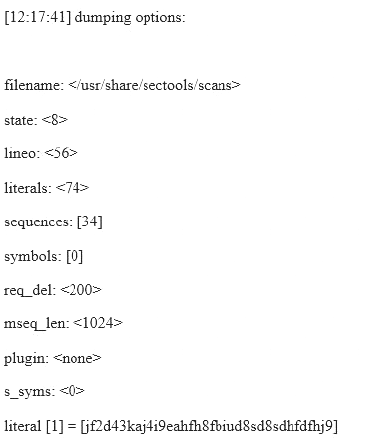
- A. Log reduction
- B. Network enumerator
- C. Fuzzer
- D. SCAP scanner
Answer: D
NEW QUESTION 26
The helpdesk department desires to roll out a remote support application for internal use on all company computers. This tool should allow remote desktop sharing, system log gathering, chat, hardware logging, inventory management, and remote registry access. The risk management team has been asked to review vendor responses to the RFQ. Which of the following questions is the MOST important?
- A. What are the protections against MITM?
- B. What accountability is built into the remote support application?
- C. What encryption standards are used in tracking database?
- D. What snapshot or “undo” features are present in the application?
- E. What encryption standards are used in remote desktop and file transfer functionality?
Answer: B
Explanation:
Incorrect Answers:
A: Man-in-the-Middle (MiTM) attacks are carried out when an attacker places himself between the sender and the receiver in the communication path, where they can intercept and modify the communication. However, the risk of a MITM is slim whereas the support staff WILL be accessing personal information.
C: Database encryption to prevent unauthorized access could be important (depending on other security controls in place). However, the risk of an unauthorized database access is slim whereas the support staff WILL be accessing personal information.
D: What snapshot or “undo” features are present in the application is a relatively unimportant question. The application may have no snapshot or “undo” features. Accounting for data access is more important than the risk of support user wanting to undo a mistake.
E: Encryption to prevent against MITM or packet sniffing attacks is important. However, the risk of such attacks is slim whereas the support staff WILL be accessing personal information. This makes the accountability question more important.
References: https://www.priv.gHYPERLINK
"https://www.priv.gc.ca/information/guide/2012/gl_acc_201204_e.asp"c.ca/information/guide/2012/gl_acc_201204_e.asp2/gl_acc_201204_e.asp
NEW QUESTION 27
A medical facility wants to purchase mobile devices for doctors and nurses. To ensure accountability, each individual will be assigned a separate mobile device. Additionally, to protect patients’ health information, management has identified the following requirements:
Data must be encrypted at rest.
The device must be disabled if it leaves the facility. The device must be disabled when tampered with
Which of the following technologies would BEST support these requirements? (Select two.)
- A. eFuse
- B. NFC
- C. GPS
- D. Biometric
- E. USB 4.1
- F. MicroSD
Answer: CD
NEW QUESTION 28
A hospital’s security team recently determined its network was breached and patient data was accessed by an external entity. The Chief Information Security Officer (CISO) of the hospital approaches the executive management team with this information, reports the vulnerability that led to the breach has already been remediated, and explains the team is continuing to follow the appropriate incident response plan. The executive team is concerned about the hospital’s brand reputation and asks the CISO when the incident should be disclosed to the affected patients. Which of the following is the MOST appropriate response?
- A. When it is mandated by their legal and regulatory requirements
- B. As soon as possible in the interest of the patients
- C. As soon as the public relations department is ready to be interviewed
- D. When all steps related to the incident response plan are completed
- E. Upon the approval of the Chief Executive Officer (CEO) to release information to the public
Answer: A
NEW QUESTION 29
......
Recommend!! Get the Full CAS-003 dumps in VCE and PDF From Certleader, Welcome to Download: https://www.certleader.com/CAS-003-dumps.html (New 443 Q&As Version)