High Quality SCS-C01 Q&A 2021
We provide real SCS-C01 exam questions and answers braindumps in two formats. Download PDF & Practice Tests. Pass Amazon-Web-Services SCS-C01 Exam quickly & easily. The SCS-C01 PDF type is available for reading and printing. You can print more and practice many times. With the help of our Amazon-Web-Services SCS-C01 dumps pdf and vce product and material, you can easily pass the SCS-C01 exam.
Check SCS-C01 free dumps before getting the full version:
NEW QUESTION 1
Your company has many AWS accounts defined and all are managed via AWS Organizations. One AWS account has a S3 bucket that has critical data. How can we ensure that all the users in the AWS organisation have access to this bucket?
Please select:
- A. Ensure the bucket policy has a condition which involves aws:PrincipalOrglD
- B. Ensure the bucket policy has a condition which involves aws:AccountNumber
- C. Ensure the bucket policy has a condition which involves aws:PrincipaliD
- D. Ensure the bucket policy has a condition which involves aws:OrglD
Answer: A
Explanation:
The AWS Documentation mentions the following
AWS Identity and Access Management (1AM) now makes it easier for you to control access to your AWS resources by using the AWS organization of 1AM principals (users and roles). For some services, you grant permissions using resource-based policies to specify the accounts and principals that can access the resource and what actions they can perform on it. Now, you can use a new condition key, aws:PrincipalOrglD, in these policies to require all principals accessing the resource to be from an account in the organization
Option B.C and D are invalid because the condition in the bucket policy has to mention aws:PrincipalOrglD For more information on controlling access via Organizations, please refer to the below Link:
https://aws.amazon.com/blogs/security/control-access-to-aws-resources-by-usins-the-aws-organization-of-iam-p (
The correct answer is: Ensure the bucket policy has a condition which involves aws:PrincipalOrglD Submit your Feedback/Queries to our Experts
NEW QUESTION 2
A Security Administrator is performing a log analysis as a result of a suspected AWS account compromise. The Administrator wants to analyze suspicious AWS CloudTrail log files but is overwhelmed by the volume of audit logs being generated.
What approach enables the Administrator to search through the logs MOST efficiently?
- A. Implement a “write-only” CloudTrail event filter to detect any modifications to the AWS account resources.
- B. Configure Amazon Macie to classify and discover sensitive data in the Amazon S3 bucket that contains the CloudTrail audit logs.
- C. Configure Amazon Athena to read from the CloudTrail S3 bucket and query the logs to examine account activities.
- D. Enable Amazon S3 event notifications to trigger an AWS Lambda function that sends an email alarm when there are new CloudTrail API entries.
Answer: C
NEW QUESTION 3
Your company makes use of S3 buckets for storing data. There is a company policy that all services should have logging enabled. How can you ensure that logging is always enabled for created S3 buckets in the AWS Account?
Please select:
- A. Use AWS Inspector to inspect all S3 buckets and enable logging for those where it is not enabled
- B. Use AWS Config Rules to check whether logging is enabled for buckets
- C. Use AWS Cloudwatch metrics to check whether logging is enabled for buckets
- D. Use AWS Cloudwatch logs to check whether logging is enabled for buckets
Answer: B
Explanation:
This is given in the AWS Documentation as an example rule in AWS Config Example rules with triggers Example rule with configuration change trigger
1. You add the AWS Config managed rule, S3_BUCKET_LOGGING_ENABLED, to your account to check whether your Amazon S3 buckets have logging enabled.
2. The trigger type for the rule is configuration changes. AWS Config runs the evaluations for the rule when an Amazon S3 bucket is created, changed, or deleted.
3. When a bucket is updated, the configuration change triggers the rule and AWS Config evaluates whether the bucket is compliant against the rule.
Option A is invalid because AWS Inspector cannot be used to scan all buckets
Option C and D are invalid because Cloudwatch cannot be used to check for logging enablement for buckets. For more information on Config Rules please see the below Link: https://docs.aws.amazon.com/config/latest/developerguide/evaluate-config-rules.html
The correct answer is: Use AWS Config Rules to check whether logging is enabled for buckets Submit your Feedback/Queries to our Experts
NEW QUESTION 4
You are planning on using the AWS KMS service for managing keys for your application. For which of the following can the KMS CMK keys be used for encrypting? Choose 2 answers from the options given below
Please select:
- A. Image Objects
- B. Large files
- C. Password
- D. RSA Keys
Answer: CD
Explanation:
The CMK keys themselves can only be used for encrypting data that is maximum 4KB in size. Hence it can be used for encryptii information such as passwords and RSA keys.
Option A and B are invalid because the actual CMK key can only be used to encrypt small amounts of data and not large amoui of data. You have to generate the data key from the CMK key in order to encrypt high amounts of data
For more information on the concepts for KMS, please visit the following URL: https://docs.aws.amazon.com/kms/latest/developereuide/concepts.htmll
The correct answers are: Password, RSA Keys Submit your Feedback/Queries to our Experts
NEW QUESTION 5
Your development team is using access keys to develop an application that has access to S3 and DynamoDB. A new security policy has outlined that the credentials should not be older than 2 months, and should be rotated. How can you achieve this?
Please select:
- A. Use the application to rotate the keys in every 2 months via the SDK
- B. Use a script to query the creation date of the key
- C. If older than 2 months, create new access key and update all applications to use it inactivate the old key and delete it.
- D. Delete the user associated with the keys after every 2 month
- E. Then recreate the user again.
- F. Delete the 1AM Role associated with the keys after every 2 month
- G. Then recreate the 1AM Role again.
Answer: B
Explanation:
One can use the CLI command list-access-keys to get the access keys. This command also returns the "CreateDate" of the keys. If the CreateDate is older than 2 months, then the keys can be deleted.
The Returns list-access-keys CLI command returns information about the access key IDs associated with the specified 1AM user. If there are none, the action returns an empty list
Option A is incorrect because you might as use a script for such maintenance activities Option C is incorrect because you would not rotate the users themselves
Option D is incorrect because you don't use 1AM roles for such a purpose For more information on the CLI command, please refer to the below Link: http://docs.aws.amazon.com/cli/latest/reference/iam/list-access-keys.htmll
The correct answer is: Use a script to query the creation date of the keys. If older than 2 months, create new access key and update all applications to use it inactivate the old key and delete it.
Submit your Feedback/Queries to our Experts
NEW QUESTION 6
A company hosts a critical web application on the AWS Cloud. This is a key revenue generating application for the company. The IT Security team is worried about potential DDos attacks against the web site. The senior management has also specified that immediate action needs to be taken in case of a potential DDos attack. What should be done in this regard?
Please select:
- A. Consider using the AWS Shield Service
- B. Consider using VPC Flow logs to monitor traffic for DDos attack and quickly take actions on a trigger of a potential attack.
- C. Consider using the AWS Shield Advanced Service
- D. Consider using Cloudwatch logs to monitor traffic for DDos attack and quickly take actions on a trigger of a potential attack.
Answer: C
Explanation:
Option A is invalid because the normal AWS Shield Service will not help in immediate action against a DDos attack. This can be done via the AWS Shield Advanced Service
Option B is invalid because this is a logging service for VPCs traffic flow but cannot specifically protect against DDos attacks.
Option D is invalid because this is a logging service for AWS Services but cannot specifically protect against DDos attacks.
The AWS Documentation mentions the following
AWS Shield Advanced provides enhanced protections for your applications running on Amazon EC2. Elastic Load Balancing (ELB), Amazon CloudFront and Route 53 against larger and more sophisticated attacks. AWS Shield Advanced is available to AWS Business Support and AWS Enterprise Support customers. AWS Shield Advanced protection provides always-on, flow-based monitoring of network traffic and active application monitoring to provide near real-time notifications of DDoS attacks. AWS Shield Advanced also gives customers highly flexible controls over attack mitigations to take actions instantly. Customers can also engage the DDoS Response Team (DRT) 24X7 to manage and mitigate their application layer DDoS attacks.
For more information on AWS Shield, please visit the below URL:
https://aws.amazon.com/shield/faqs;
The correct answer is: Consider using the AWS Shield Advanced Service Submit your Feedback/Queries to our Experts
NEW QUESTION 7
Your company has defined a set of S3 buckets in AWS. They need to monitor the S3 buckets and know the source IP address and the person who make requests to the S3 bucket. How can this be achieved?
Please select:
- A. Enable VPC flow logs to know the source IP addresses
- B. Monitor the S3 API calls by using Cloudtrail logging
- C. Monitor the S3 API calls by using Cloudwatch logging
- D. Enable AWS Inspector for the S3 bucket
Answer: B
Explanation:
The AWS Documentation mentions the following
Amazon S3 is integrated with AWS CloudTrail. CloudTrail is a service that captures specific API calls made to Amazon S3 from your AWS account and delivers the log files to an Amazon S3 bucket that you specify. It captures API calls made from the Amazon S3 console or from the Amazon S3 API.
Using the information collected by CloudTrail, you can determine what request was made to Amazon S3, the source IP address from which the request was made, who made the request when it was made, and so on Options A,C and D are invalid because these services cannot be used to get the source IP address of the calls to S3 buckets
For more information on Cloudtrail logging, please refer to the below Link: https://docs.aws.amazon.com/AmazonS3/latest/dev/cloudtrail-logeins.htmll
The correct answer is: Monitor the S3 API calls by using Cloudtrail logging Submit your Feedback/Queries to our Experts
NEW QUESTION 8
A company has hired a third-party security auditor, and the auditor needs read-only access to all AWS resources and logs of all VPC records and events that have occurred on AWS. How can the company meet the auditor's requirements without comprising security in the AWS environment? Choose the correct answer from the options below
Please select:
- A. Create a role that has the required permissions for the auditor.
- B. Create an SNS notification that sends the CloudTrail log files to the auditor's email when CIoudTrail delivers the logs to S3, but do not allow the auditor access to the AWS environment.
- C. The company should contact AWS as part of the shared responsibility model, and AWS will grant required access to th^ third-party auditor.
- D. Enable CloudTrail logging and create an 1AM user who has read-only permissions to the required AWS resources, including the bucket containing the CloudTrail logs.
Answer: D
Explanation:
AWS CloudTrail is a service that enables governance, compliance, operational auditing, and risk auditing of your AWS account. With CloudTrail, you can log, continuously monitor, and retain events related to API calls across your AWS infrastructure. CloudTrail provides a history of AWS API calls for your account including API calls made through the AWS Management Console, AWS SDKs, command line tools, and other AWS services. This history simplifies security analysis, resource change tracking, and troubleshooting.
Option A and C are incorrect since Cloudtrail needs to be used as part of the solution Option B is incorrect since the auditor needs to have access to Cloudtrail
For more information on cloudtrail, please visit the below URL: https://aws.amazon.com/cloudtraiL
The correct answer is: Enable CloudTrail logging and create an 1AM user who has read-only permissions to the required AWS resources, including the bucket containing the CloudTrail logs.
Submit your Feedback/Queries to our Experts
NEW QUESTION 9
You have an S3 bucket defined in AWS. You want to ensure that you encrypt the data before sending it across the wire. What is the best way to achieve this.
Please select:
- A. Enable server side encryption for the S3 bucke
- B. This request will ensure that the data is encrypted first.
- C. Use the AWS Encryption CLI to encrypt the data first
- D. Use a Lambda function to encrypt the data before sending it to the S3 bucket.
- E. Enable client encryption for the bucket
Answer: B
Explanation:
One can use the AWS Encryption CLI to encrypt the data before sending it across to the S3 bucket. Options A and C are invalid because this would still mean that data is transferred in plain text Option D is invalid because you cannot just enable client side encryption for the S3 bucket For more information on Encrypting and Decrypting data, please visit the below URL:
https://aws.amazonxom/blogs/securirv/how4o-encrvpt-and-decrypt-your-data-with-the-aws-encryption-cl
The correct answer is: Use the AWS Encryption CLI to encrypt the data first Submit your Feedback/Queries to our Experts
NEW QUESTION 10
An organization is using AWS CloudTrail, Amazon CloudWatch Logs, and Amazon CloudWatch to send alerts when new access keys are created. However, the alerts are no longer appearing in the Security Operations mail box.
Which of the following actions would resolve this issue?
- A. In CloudTrail, verify that the trail logging bucket has a log prefix configured.
- B. In Amazon SNS, determine whether the “Account spend limit” has been reached for this alert.
- C. In SNS, ensure that the subscription used by these alerts has not been deleted.
- D. In CloudWatch, verify that the alarm threshold “consecutive periods” value is equal to, or greater than 1.
Answer: B
NEW QUESTION 11
You company has mandated that all data in AWS be encrypted at rest. How can you achieve this for EBS volumes? Choose 2 answers from the options given below
Please select:
- A. Use Windows bit locker for EBS volumes on Windows instances
- B. Use TrueEncrypt for EBS volumes on Linux instances
- C. Use AWS Systems Manager to encrypt the existing EBS volumes
- D. Boot EBS volume can be encrypted during launch without using custom AMI
Answer: AB
Explanation:
EBS encryption can also be enabled when the volume is created and not for existing volumes. One can use existing tools for OS level encryption.
Option C is incorrect.
AWS Systems Manager is a management service that helps you automatically collect software inventory, apply OS patches, create system images, and configure Windows and Linux operating systems.
Option D is incorrect
You cannot choose to encrypt a non-encrypted boot volume on instance launch. To have encrypted boot volumes during launch , your custom AMI must have it's boot volume encrypted before launch.
For more information on the Security Best practices, please visit the following URL: com/whit Security Practices.
The correct answers are: Use Windows bit locker for EBS volumes on Windows instances. Use TrueEncrypt for EBS volumes on Linux instances
Submit your Feedback/Queries to our Experts
NEW QUESTION 12
Compliance requirements state that all communications between company on-premises hosts and EC2 instances be encrypted in transit. Hosts use custom proprietary protocols for their communication, and EC2 instances need to be fronted by a load balancer for increased availability.
Which of the following solutions will meet these requirements?
- A. Offload SSL termination onto an SSL listener on a Classic Load Balancer, and use a TCP connection between the load balancer and the EC2 instances.
- B. Route all traffic through a TCP listener on a Classic Load Balancer, and terminate the TLS connection on the EC2 instances.
- C. Create an HTTPS listener using an Application Load Balancer, and route all of the communication through that load balancer.
- D. Offload SSL termination onto an SSL listener using an Application Load Balancer, and re-spawn and SSL connection between the load balancer and the EC2 instances.
Answer: B
NEW QUESTION 13
You are planning on hosting a web application on AWS. You create an EC2 Instance in a public subnet. This instance needs to connect to an EC2 Instance that will host an Oracle database. Which of the following steps should be followed to ensure a secure setup is in place? Select 2 answers.
Please select:
- A. Place the EC2 Instance with the Oracle database in the same public subnet as the Web server for faster communication
- B. Place the EC2 Instance with the Oracle database in a separate private subnet
- C. Create a database security group and ensure the web security group to allowed incoming access
- D. Ensure the database security group allows incoming traffic from 0.0.0.0/0
Answer: BC
Explanation:
The best secure option is to place the database in a private subnet. The below diagram from the AWS Documentation shows this setup. Also ensure that access is not allowed from all sources but just from the web servers.
C:UserswkDesktopmudassarUntitled.jpg
Option A is invalid because databases should not be placed in the public subnet
Option D is invalid because the database security group should not allow traffic from the internet For more information on this type of setup, please refer to the below URL:
https://docs.aws.amazon.com/AmazonVPC/latest/UserGuideA/PC Scenario2.
The correct answers are: Place the EC2 Instance with the Oracle database in a separate private subnet Create a database security group and ensure the web security group to allowed incoming access
Submit your Feedback/Queries to our Experts
NEW QUESTION 14
A security engineer must ensure that all infrastructure launched in the company AWS account be monitored for deviation from compliance rules, specifically that all EC2 instances are launched from one of a specified list of AM Is and that all attached EBS volumes are encrypted. Infrastructure not in compliance should be terminated. What combination of steps should the Engineer implement? Select 2 answers from the options given below.
Please select:
- A. Set up a CloudWatch event based on Trusted Advisor metrics
- B. Trigger a Lambda function from a scheduled CloudWatch event that terminates non-compliant infrastructure.
- C. Set up a CloudWatch event based on Amazon inspector findings
- D. Monitor compliance with AWS Config Rules triggered by configuration changes
- E. Trigger a CLI command from a CloudWatch event that terminates the infrastructure
Answer: BD
Explanation:
You can use AWS Config to monitor for such Event
Option A is invalid because you cannot set Cloudwatch events based on Trusted Advisor checks.
Option C is invalid Amazon inspector cannot be used to check whether instances are launched from a specific A
Option E is invalid because triggering a CLI command is not the preferred option, instead you should use Lambda functions for all automation purposes.
For more information on Config Rules please see the below Link: https://docs.aws.amazon.com/config/latest/developerguide/evaluate-config-rules.html
These events can then trigger a lambda function to terminate instances For more information on Cloudwatch events please see the below Link:
https://docs.aws.amazon.com/AmazonCloudWatch/latest/events/WhatlsCloudWatchEvents. (
The correct answers are: Trigger a Lambda function from a scheduled Cloudwatch event that terminates non-compliant infrastructure., Monitor compliance with AWS Config Rules triggered by configuration changes
Submit your Feedback/Queries to our Experts
NEW QUESTION 15
The Security Engineer is given the following requirements for an application that is running on Amazon EC2 and managed by using AWS CloudFormation templates with EC2 Auto Scaling groups:
-Have the EC2 instances bootstrapped to connect to a backend database.
-Ensure that the database credentials are handled securely.
-Ensure that retrievals of database credentials are logged.
Which of the following is the MOST efficient way to meet these requirements?
- A. Pass databases credentials to EC2 by using CloudFormation stack parameters with the property set to tru
- B. Ensure that the instance is configured to log to Amazon CloudWatch Logs.
- C. Store database passwords in AWS Systems Manager Parameter Store by using SecureString parameters.Set the IAM role for the EC2 instance profile to allow access to the parameters.
- D. Create an AWS Lambda that ingests the database password and persists it to Amazon S3 with server-side encryptio
- E. Have the EC2 instances retrieve the S3 object on startup, and log all script invocations to syslog.
- F. Write a script that is passed in as UserData so that it is executed upon launch of the EC2 instance.Ensure that the instance is configured to log to Amazon CloudWatch Logs.
Answer: C
NEW QUESTION 16
A security team is creating a response plan in the event an employee executes unauthorized actions on AWS infrastructure. They want to include steps to determine if the employee's 1AM permissions changed as part of the incident.
What steps should the team document in the plan? Please select:
- A. Use AWS Config to examine the employee's 1AM permissions prior to the incident and compare them to the employee's current 1AM permissions.
- B. Use Made to examine the employee's 1AM permissions prior to the incident and compare them to the employee's A current 1AM permissions.
- C. Use CloudTrail to examine the employee's 1AM permissions prior to the incident and compare them to the employee's current 1AM permissions.
- D. Use Trusted Advisor to examine the employee's 1AM permissions prior to the incident and compare them to the employee's current 1AM permissions.
Answer: A
Explanation:
You can use the AWSConfig history to see the history of a particular item.
The below snapshot shows an example configuration for a user in AWS Config 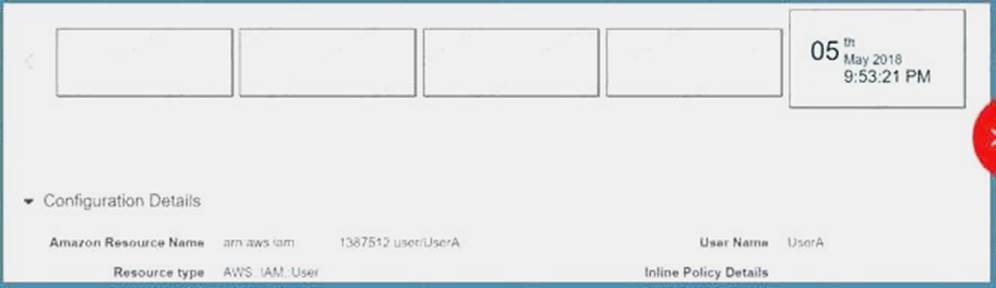
C:UserswkDesktopmudassarUntitled.jpg
Option B,C and D are all invalid because these services cannot be used to see the history of a particular configuration item. This can only be accomplished by AWS Config.
For more information on tracking changes in AWS Config, please visit the below URL: https://docs.aws.amazon.com/AmazonCloudFront/latest/DeveloperGuide/TrackineChanees.htmll
The correct answer is: Use AWS Config to examine the employee's 1AM permissions prior to the incident and compare them the employee's current 1AM permissions.
Submit your Feedback/Queries to our Experts
NEW QUESTION 17
A company has decided to migrate sensitive documents from on-premises data centers to Amazon S3. Currently, the hard drives are encrypted to meet a compliance requirement regarding data encryption. The CISO wants to improve security by encrypting each file using a different key instead of a single key. Using a different key would limit the security impact of a single exposed key.
Which of the following requires the LEAST amount of configuration when implementing this approach?
- A. Place each file into a different S3 bucke
- B. Set the default encryption of each bucket to use a different AWS KMS customer managed key.
- C. Put all the files in the same S3 bucke
- D. Using S3 events as a trigger, write an AWS Lambda function to encrypt each file as it is added using different AWS KMS data keys.
- E. Use the S3 encryption client to encrypt each file individually using S3-generated data keys
- F. Place all the files in the same S3 bucke
- G. Use server-side encryption with AWS KMS-managed keys (SSE-KMS) to encrypt the data
Answer: D
NEW QUESTION 18
An application has a requirement to be resilient across not only Availability Zones within the application’s primary region but also be available within another region altogether.
Which of the following supports this requirement for AWS resources that are encrypted by AWS KMS?
- A. Copy the application’s AWS KMS CMK from the source region to the target region so that it can be used to decrypt the resource after it is copied to the target region.
- B. Configure AWS KMS to automatically synchronize the CMK between regions so that it can be used to decrypt the resource in the target region.
- C. Use AWS services that replicate data across regions, and re-wrap the data encryption key created in the source region by using the CMK in the target region so that the target region’s CMK can decrypt the database encryption key.
- D. Configure the target region’s AWS service to communicate with the source region’s AWS KMS so that it can decrypt the resource in the target region.
Answer: C
NEW QUESTION 19
A company requires that IP packet data be inspected for invalid or malicious content. Which of the following approaches achieve this requirement? (Choose two.)
- A. Configure a proxy solution on Amazon EC2 and route all outbound VPC traffic through i
- B. Perform inspection within proxy software on the EC2 instance.
- C. Configure the host-based agent on each EC2 instance within the VP
- D. Perform inspection within the host-based agent.
- E. Enable VPC Flow Logs for all subnets in the VP
- F. Perform inspection from the Flow Log data within Amazon CloudWatch Logs.
- G. Configure Elastic Load Balancing (ELB) access log
- H. Perform inspection from the log data within the ELB access log files.
- I. Configure the CloudWatch Logs agent on each EC2 instance within the VP
- J. Perform inspection from the log data within CloudWatch Logs.
Answer: AB
NEW QUESTION 20
A company had one of its Amazon EC2 key pairs compromised. A Security Engineer must identify which current Linux EC2 instances were deployed and used the compromised key pair.
How can this task be accomplished?
- A. Obtain the list of instances by directly querying Amazon EC2 using: aws ec2 describe-instances --fi1ters "Name=key-name,Values=KEYNAMEHERE".
- B. Obtain the fingerprint for the key pair from the AWS Management Console, then search for the fingerprint in the Amazon Inspector logs.
- C. Obtain the output from the EC2 instance metadata using: curl http://169.254.169.254/latest/meta-data/public- keys/0/.
- D. Obtain the fingerprint for the key pair from the AWS Management Console, then search for the fingerprint in Amazon CloudWatch Logs using: aws logs filter-log-events.
Answer: D
NEW QUESTION 21
You have an instance setup in a test environment in AWS. You installed the required application and the promoted the server to a production environment. Your IT Security team has advised that there maybe traffic flowing in from an unknown IP address to port 22. How can this be mitigated immediately?
Please select:
- A. Shutdown the instance
- B. Remove the rule for incoming traffic on port 22 for the Security Group
- C. Change the AMI for the instance
- D. Change the Instance type for the instance
Answer: B
Explanation:
In the test environment the security groups might have been opened to all IP addresses for testing purpose. Always to ensure to remove this rule once all testing is completed.
Option A, C and D are all invalid because this would affect the application running on the server. The easiest way is just to remove the rule for access on port 22.
For more information on authorizing access to an instance, please visit the below URL: https://docs.aws.amazon.com/AWSEC2/latest/UserGuide/authorizing-access-to-an-instance.htmll
The correct answer is: Remove the rule for incoming traffic on port 22 for the Security Group Submit your Feedback/Queries to our Experts
NEW QUESTION 22
You need to create a Linux EC2 instance in AWS. Which of the following steps is used to ensure secure authentication the EC2 instance from a windows machine. Choose 2 answers from the options given below.
Please select:
- A. Ensure to create a strong password for logging into the EC2 Instance
- B. Create a key pair using putty
- C. Use the private key to log into the instance
- D. Ensure the password is passed securely using SSL
Answer: BC
Explanation:
The AWS Documentation mentions the following
You can use Amazon EC2 to create your key pair. Alternatively, you could use a third-party tool and then import the public key to Amazon EC2. Each key pair requires a name. Be sure to choose a name that is easy to remember. Amazon EC2 associates the public key with the name that you specify as the key name.
Amazon EC2 stores the public key only, and you store the private key. Anyone who possesses your private key can decrypt login information, so it's important that you store your private keys in a secure place.
Options A and D are incorrect since you should use key pairs for secure access to Ec2 Instances
For more information on EC2 key pairs, please refer to below URL: https://docs.aws.amazon.com/AWSEC2/latest/UserGuide/ec2-key-pairs.html
The correct answers are: Create a key pair using putty. Use the private key to log into the instance Submit your Feedback/Queries to our Experts
NEW QUESTION 23
Your application currently uses customer keys which are generated via AWS KMS in the US east region. You now want to use the same set of keys from the EU-Central region. How can this be accomplished?
Please select:
- A. Export the key from the US east region and import them into the EU-Central region
- B. Use key rotation and rotate the existing keys to the EU-Central region
- C. Use the backing key from the US east region and use it in the EU-Central region
- D. This is not possible since keys from KMS are region specific
Answer: D
Explanation:
Option A is invalid because keys cannot be exported and imported across regions. Option B is invalid because key rotation cannot be used to export keys
Option C is invalid because the backing key cannot be used to export keys This is mentioned in the AWS documentation
What geographic region are my keys stored in?
Keys are only stored and used in the region in which they are created. They cannot be transferred to another region. For example; keys created in the EU-Central (Frankfurt) region are only stored and used within the EU-Central (Frankfurt) region
For more information on KMS please visit the following URL: https://aws.amazon.com/kms/faqs/
The correct answer is: This is not possible since keys from KMS are region specific Submit your Feedback/Queries to our Experts
NEW QUESTION 24
A threat assessment has identified a risk whereby an internal employee could exfiltrate sensitive data from production host running inside AWS (Account 1). The threat was documented as follows:
Threat description: A malicious actor could upload sensitive data from Server X by configuring credentials for an AWS account (Account 2) they control and uploading data to an Amazon S3 bucket within their control.
Server X has outbound internet access configured via a proxy server. Legitimate access to S3 is required so that the application can upload encrypted files to an S3 bucket. Server X is currently using an IAM instance role. The proxy server is not able to inspect any of the server communication due to TLS encryption.
Which of the following options will mitigate the threat? (Choose two.)
- A. Bypass the proxy and use an S3 VPC endpoint with a policy that whitelists only certain S3 buckets within Account 1.
- B. Block outbound access to public S3 endpoints on the proxy server.
- C. Configure Network ACLs on Server X to deny access to S3 endpoints.
- D. Modify the S3 bucket policy for the legitimate bucket to allow access only from the public IP addresses associated with the application server.
- E. Remove the IAM instance role from the application server and save API access keys in a trusted and encrypted application config file.
Answer: AD
NEW QUESTION 25
You want to ensure that you keep a check on the Active EBS Volumes, Active snapshots and Elastic IP addresses you use so that you don't go beyond the service limit. Which of the below services can help in this regard?
Please select:
- A. AWS Cloudwatch
- B. AWS EC2
- C. AWS Trusted Advisor
- D. AWS SNS
Answer: C
Explanation:
Below is a snapshot of the service limits that the Trusted Advisor can monitor C:UserswkDesktopmudassarUntitled.jpg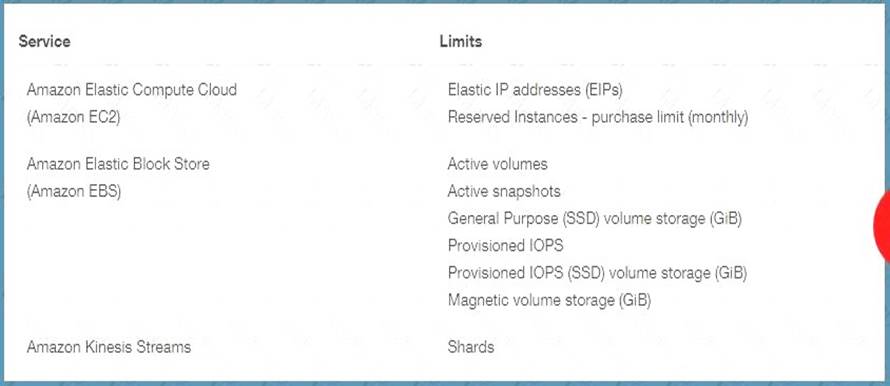
Option A is invalid because even though you can monitor resources, it cannot be checked against the service limit.
Option B is invalid because this is the Elastic Compute cloud service Option D is invalid because it can be send notification but not check on service limit For more information on the Trusted Advisor monitoring, please visit the below URL:
https://aws.amazon.com/premiumsupport/ta-faqs> The correct answer is: AWS Trusted Advisor Submit your Feedback/Queries to our Experts
NEW QUESTION 26
A Systems Administrator has written the following Amazon S3 bucket policy designed to allow access to an S3 bucket for only an authorized AWS IAM user from the IP address range 10.10.10.0/24: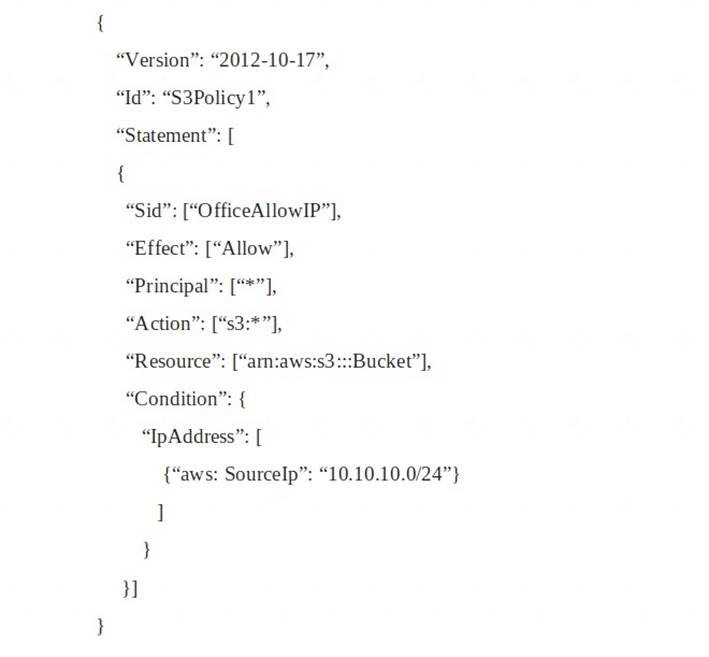
When trying to download an object from the S3 bucket from 10.10.10.40, the IAM user receives an access denied message.
What does the Administrator need to change to grant access to the user?
- A. Change the “Resource” from “arn: aws:s3:::Bucket” to “arn:aws:s3:::Bucket/*”.
- B. Change the “Principal” from “*” to {AWS:”arn:aws:iam: : account-number: user/username”}
- C. Change the “Version” from “2012-10-17” to the last revised date of the policy
- D. Change the “Action” from [“s3:*”] to [“s3:GetObject”, “s3:ListBucket”]
Answer: A
NEW QUESTION 27
One of your company's EC2 Instances have been compromised. The company has strict po thorough investigation on finding the culprit for the security breach. What would you do in from the options given below.
Please select:
- A. Take a snapshot of the EBS volume
- B. Isolate the machine from the network
- C. Make sure that logs are stored securely for auditing and troubleshooting purpose
- D. Ensure all passwords for all 1AM users are changed
- E. Ensure that all access kevs are rotated.
Answer: ABC
Explanation:
Some of the important aspects in such a situation are
1) First isolate the instance so that no further security harm can occur on other AWS resources
2) Take a snapshot of the EBS volume for further investigation. This is incase if you need to shutdown the initial instance and do a separate investigation on the data
3) Next is Option C. This indicates that we have already got logs and we need to make sure that it is stored securely so that n unauthorised person can access it and manipulate it.
Option D and E are invalid because they could have adverse effects for the other 1AM users. For more information on adopting a security framework, please refer to below URL https://d1 .awsstatic.com/whitepapers/compliance/NIST Cybersecurity Framework
Note:
In the question we have been asked to take actions to find the culprit and to help the investigation or to further reduce the damage that has happened due to the security breach. So by keeping logs secure is one way of helping the investigation.
The correct answers are: Take a snapshot of the EBS volume. Isolate the machine from the network. Make sure that logs are stored securely for auditing and troubleshooting purpose
Submit your Feedback/Queries to our Experts
NEW QUESTION 28
An application makes calls to AWS services using the AWS SDK. The application runs on Amazon EC2 instances with an associated IAM role. When the application attempts to access an object within an Amazon S3 bucket; the Administrator receives the following error message: HTTP 403: Access Denied.
Which combination of steps should the Administrator take to troubleshoot this issue? (Select three.)
- A. Confirm that the EC2 instance's security group authorizes S3 access.
- B. Verify that the KMS key policy allows decrypt access for the KMS key for this IAM principle.
- C. Check the S3 bucket policy for statements that deny access to objects.
- D. Confirm that the EC2 instance is using the correct key pair.
- E. Confirm that the IAM role associated with the EC2 instance has the proper privileges.
- F. Confirm that the instance and the S3 bucket are in the same Region.
Answer: ABC
NEW QUESTION 29
An auditor needs access to logs that record all API events on AWS. The auditor only needs read-only access to the log files and does not need access to each AWS account. The company has multiple AWS accounts, and the auditor needs access to all the logs for all the accounts. What is the best way to configure access for the auditor to view event logs from all accounts? Choose the correct answer from the options below
Please select:
- A. Configure the CloudTrail service in each AWS account, and have the logs delivered to an AWS bucket on each account, while granting the auditor permissions to the bucket via roles in the secondary accounts and a single primary 1AM account that can assume a read-only role in the secondary AWS accounts.
- B. Configure the CloudTrail service in the primary AWS account and configure consolidated billing for all the secondary account
- C. Then grant the auditor access to the S3 bucket that receives the CloudTrail log files.
- D. Configure the CloudTrail service in each AWS account and enable consolidated logging inside of CloudTrail.
- E. Configure the CloudTrail service in each AWS account and have the logs delivered to a single AWS bucket in the primary account and erant the auditor access to that single bucket in the orimarv account.
Answer: D
Explanation:
Given the current requirements, assume the method of "least privilege" security design and only allow the auditor access to the minimum amount of AWS resources as possibli
AWS CloudTrail is a service that enables governance, compliance, operational auditing, and risk auditing of your AWS account. With CloudTrail, you can log, continuously monitor, and retain events related to API calls across your AWS infrastructure. CloudTrail provides a history of AWS API calls for your account including API calls made through the AWS Management Console, AWS SDKs, command line tools, and other AWS services. This history simplifies security analysis, resource change tracking, and troubleshooting
only be granted access in one location
Option Option A is incorrect since the auditor should B is incorrect since consolidated billing is not a key requirement as part of the question
Option C is incorrect since there is not consolidated logging
For more information on Cloudtrail please refer to the below URL: https://aws.amazon.com/cloudtraiL
(
The correct answer is: Configure the CloudTrail service in each AWS account and have the logs delivered to a single AWS bud in the primary account and grant the auditor access to that single bucket in the primary account.
Submit your Feedback/Queries to our Experts
NEW QUESTION 30
......
100% Valid and Newest Version SCS-C01 Questions & Answers shared by prep-labs.com, Get Full Dumps HERE: https://www.prep-labs.com/dumps/SCS-C01/ (New 330 Q&As)