Oracle 1Z0-066 Dumps Questions 2021
We offers . "Oracle Database 12c: Data Guard Administration", also known as 1Z0-066 exam, is a Oracle Certification. This set of posts, Passing the 1Z0-066 exam with , will help you answer those questions. The covers all the knowledge points of the real exam. 100% real and revised by experts!
Online Oracle 1Z0-066 free dumps demo Below:
NEW QUESTION 1
Which three are required in order to use Real-Time Query without lagging behind the primary?
- A. There must be standby redo logs on the standby database
- B. There must be standby redo logs on the primary database.
- C. The primary must ship redo asynchronously.
- D. COMPATIBLE must be set to 11.1.0 or higher.
- E. Real-Time apply must be enabled on the standby.
Answer: ADE
NEW QUESTION 2
Which statement is true regarding Oracle Net connectivity for a Data Guard Broker configuration?
- A. To start SQL apply on a logical standby database, a TNS entry enabling connectivity to the primary database instance must be defined on the logical standby database host.
- B. the LOCALJJSTERNER initialization parameter must be set to the listener used to register the primary database instance.
- C. To enable Reatime Query on a physical standby database, a TNS entry enabling connectivity to the standby database instance must be defined on the primary database host.
- D. A TNS enabling connectivity to the primary database instance must be defined on each of the standby database hosts.
- E. A TNS entry or entries enabling connectivity to standby database instance(s) must bedefined on the primary database host.
Answer: D
NEW QUESTION 3
Attempting to start the observer raises an error: DGMGRL> start observer:
DGM-16954: Unable to open and lock the Observer configuration file Failed. Identify two possible reasons for this error
- A. Fast-Start Failover is not yet enabled for this Data Guard configuration
- B. The observer configuration file is marked read-only.
- C. There is already an observer running for this Data Guard configuration.
- D. There is another observer running for a Data Guard configuration which uses the same observer configuration file
- E. The broker configuration has not yet been created.
Answer: BD
NEW QUESTION 4
Examine the Data Guard configuration:
DGMGRL > show configuration; Configuration-Animals
Protection Mode MaxPerformance Databases
dogs-Primary database sheep-Snapshot standby database cats-Snapshot standby database
Fast-Start Failover: DISABLED Configuration Status: SUCCESS
You receive an error while attempting to raise the protection mode to Maximum Availability: DGMGDRL> edit configuration set protection mode as max availability;
Error ORA-16627 operation disallowed since no standby databases would remain to support protection mode Failed.
Identify two statements that you can execute, either one of which will enable successful raising of the protection mode to Maximum Availability.
- A. DGMGRL> convert database sheep to physical standby;
- B. DGMGRL> convert database cats to physical standby;
- C. DGMGRL> edit database dogs set property LogXptMode= fastsync;
- D. DGMGRL> edit database sheep set property LogXptMode= fastsync;
- E. DGMGRL> edit database cats set property LogXptMode= sync;
Answer: BE
NEW QUESTION 5
Which three are benefits of using the Data Guard Broker to manage standby databases?
- A. it simplifies physical standby database creation
- B. It provides an easy failover capability using a single command.
- C. it coordinates database state transitions and updates database properties dynamically.
- D. it automatically changes database properties after the protection mode for a configuration is changed
- E. It provides an easy switchover capability using a single command.
- F. It simplifies logical standby database creation.
Answer: BCE
NEW QUESTION 6
Which two Data Guard monitoring activities may be performed using Enterprise Manager Cloud Control?
- A. monitoring the redo apply rate on a physical standby
- B. monitoring the redo apply rate on a logical standby
- C. monitoring the undo generation rate on a logical standby
- D. monitoring the redo apply rate on a snapshot standby
- E. monitoring the transport lag
- F. monitoring the undo generation rate on the primary
Answer: AE
NEW QUESTION 7
You must propose an Oracle Data Guard configuration tor a database supporting an OLTP workload that meets these permanent requirements:
1. Data loss is not permitted.
2. Read-only applications should not connect to the primary database instance. Additionally, there are these requirements, only one of which is ever done at any one time:
3. It should be possible to apply and test designated patches with a minimum amount of downtime.
4. Upgrading to a new database release should be performed with the least possible amount of downtime.
5. New application software releases should be tested against an exact up-to-date replica
of the production database.
You propose a primary database with one physical standby database configured in Maximum Protection mode.
Which requirements do you meet?
- A. 2,3, 4, and 5
- B. 1,2, 3,4, and 5
- C. 1 and 2
- D. only requirement 5
- E. only requirement 1
Answer: C
NEW QUESTION 8
Examine the Data Guard configuration: DGMGRL> show configuration Configuration -Animals
Protection Mode: MaxAvailability Databases:
dogs- Primary database
sheep- (*) Physical standby database cats- Physical standby database
Fast-Start Failover: ENABLED Configuration Status: SUCCESS
What happens if you issue "switchover" to sheep;" at the DGMGRL prompt?
- A. The switchover succeeds but Dogs need to be reinstated
- B. The switchover succeeds but Fast-Start Failover is suspended.
- C. The switchover succeeds and Cats become the new failover target.
- D. The switchover succeeds and Dogs become the new failover target
- E. it results in an error indicating that a switchover is not allowed.
Answer: D
NEW QUESTION 9
You are required to change the Data Guard Configuration protection mode from MAXPERFORMANCE to MAXAVAJLABILITY using Enterprise Manager Cloud Control
Which two are true about this change?
- A. If the primary database cannot write its redo to at least one synchronized standby database, then the protection level remains unchanged.
- B. The primary database instance will remain up and running, if it cannot write redo to at least one synchronized standby database.
- C. Transactions will not commit until all redo data needed to recover those transactions are written to the online redo log, and to the standby redo log on at least one synchronizes standby database.
- D. Fast start failover can be enabled when making the chance.
- E. Real time apply will be automatically turned on.
Answer: BC
NEW QUESTION 10
Which three are true about using RMAN in a Data Guard environment?
- A. A recovery catalog is required when RMAN is used to take backups from a logical standby database in a Data Guard configuration if you plan to recover the primary using those backups.
- B. Backups of archived redo logs taken on a physical standby are interchangeable with a primary.
- C. A recovery catalog is required when RMAN is used to take backups from a physical standby database if you plan to recover the primary using those backups
- D. Backups of control files taken on a physical standby are not interchangeable with a primary.
- E. Backups of data files taken on a physical standby are interchangeable with a primary.
Answer: BCE
NEW QUESTION 11
Examine the Fast-start configuration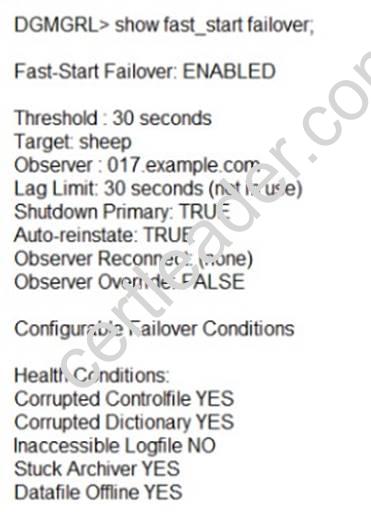
Oracle Error Conditions: (none) Which three are true?
- A. The observer will initiate a failover when the primary database is unable to produce local archived redo log files.
- B. An automatic failover will be initiated even if the target standby database lags behind the primary
- C. The observer is running
- D. a failover may occur if the observer has lost connectivity to the primary database, even if the Fast-Start Failover target standby database has a good connection to the primary database
- E. The configuration operates in Maximum Availability mode
- F. The configuration operates in Maximum Performance mode
Answer: ACE
NEW QUESTION 12
Your Data Guard environment consists of these components and settings:
1. A primary database supporting an OLTP workload 2 A remote physical standby database
3. Real-time query is enabled
4. The redo transport mode is set to SYNC.
5. The protection mode is set to Maximum Availability
Which two are true regarding the DelayMins Database Property for the standby database?
- A. it can only be enabled for a configuration in Maximum Performance mode.
- B. It allows user errors on the primary to be recovered by using the physical standby database.
- C. It enables you to bypass the default network timeout interval specified for the standby redo transport destination.
- D. it can only be enabled for a configuration in Maximum Availability mode.
- E. It allows logical corruptions on the primary to be recovered by using the physical standby database.
- F. It specifies a delay before the primary ships redo to the standby destination havingDelayMins set.
Answer: BF
NEW QUESTION 13
Examine the Data Guard configuration: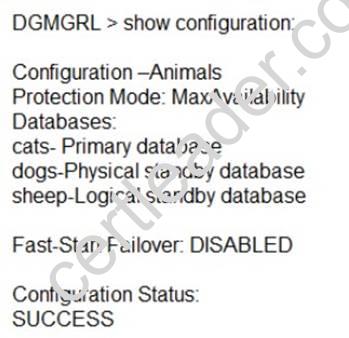
Which three will be true after a switchover to Dogs?
- A. Sheep will be an enabled logical standby database.
- B. Cats will be an enabled physical standby database
- C. Dogs will be the primary database
- D. Sheep will be a disabled logical standby database
- E. Cats will be a disabled physical standby database
Answer: BCE
NEW QUESTION 14
Which four statements are true regarding SQL Apply filters for a logical standby database?
- A. They can be used to skip execution of DML triggers on a table while allowing the DML to execute.
- B. They can be used to skip ALTER SYSTEM and ALTER DATABASE commands
- C. They can be used to stop SQL apply if it encounters an error.
- D. They can be used to skip all SQL statements executed on a specific pluggable database (PDB) within a standby multitenant container database (CDB).
- E. They can only be used to skip DML statements on a table
- F. They can be used to skip ALTER TABLE commands on a specific tables
- G. They can be used to skip CREATE TABLE commands
Answer: ACFG
NEW QUESTION 15
A query on the view DBA_LOGSTBY_UNSUPPORTED on your primary database returns no rows
As a result of this, you decide that an upgrade may use logical standby databases. Which two are true about upgrading Data Guard environments consisting of one logical
standby database running on a separate host from the primary?
- A. The upgrade always requires downtown until the upgrade of the logical standby is completed
- B. Using manual upgrade, catctl.pl can be executed in some cases on the primary and standby database simultaneously.
- C. The upgrade always required downtime until the upgrade of the primary is completed
- D. Using manual upgrade, catupgr.sql needs to run on the primary database only.
- E. SQL Apply on the local standby database must be stopped while the primary database is upgraded.
- F. Fast-Start Failover can be used to protect the primary database during the upgrade.
Answer: BE
NEW QUESTION 16
Which two are true about rolling release upgrades in a Data Guard environment?
- A. The background process DMON must be enabled on the primary and standby databases during a rolling release upgrade procedure
- B. A physical standby database can be converted to a logical standby database temporarily.
- C. Rolling release upgrades require the background process RVWR to write flashback logs on the standby database.
- D. The KEEP IDENTITY clause ensures that a logical standby database keeps the same DBID as the primary database.
- E. The recovery point objective increases proportionally to the duration of the rolling release upgrade procedure.
Answer: BD
Thanks for reading the newest 1Z0-066 exam dumps! We recommend you to try the PREMIUM Surepassexam 1Z0-066 dumps in VCE and PDF here: https://www.surepassexam.com/1Z0-066-exam-dumps.html (184 Q&As Dumps)