Oracle 1Z0-063 Exam Questions 2021
Want to know features? Want to lear more about experience? Study . Gat a success with an absolute guarantee to pass Oracle 1Z0-063 (Oracle Database 12c: Advanced Administration) test on your first attempt.
Check 1Z0-063 free dumps before getting the full version:
NEW QUESTION 1
Examine the resources consumed by a database instance whose current Resource Manager plan is displayed. SQL> SELECT name, active_sessions, queue_length,
consumed_cpu_time, cpu_waits, cpu_wait_time FROM v$rsrc_consumer_group;
Which two statements are true? (Choose two.)
- A. An attempt to start a new session by a user belonging to DSS_QUERIES fails with an error.
- B. An attempt to start a new session by a user belonging to OTHE_GROUPS fails with an error.
- C. The CPU_WAIT_TIME column indicates the total time that sessions in the consumer group waited for the CPU due to resource management.
- D. The CPU_WAIT_TIME column indicates the total time that sessions in the consumer group waited for the CPU due to I/O waits and latch or enqueue contention.
- E. A user belonging to the DSS_QUERIES resource consumer group can create a new session but the session will be queued.
Answer: CE
NEW QUESTION 2
Your database supports a Decision Support System (DSS) workload that involves the execution of complex
queries. Currently, the database is running with peak workload. You want to analyze some of the most resource-intensive statements cached in the library cache.
What must you run to receive recommendations on the efficient use of indexes and materialized views to improve query performance?
- A. SQL Performance Analyzer
- B. SQL Access Advisor
- C. SQL Tuning Advisor
- D. Automatic Workload Repository (AWR) report
- E. Automatic Database Diagnostic Monitor (ADDM)
Answer: B
NEW QUESTION 3
You need to perform a block media recovery on the tools01.dbf data file in your database by using Recovery Manager (RMAN).
Which two are prerequisites for performing this operation? (Choose two.)
- A. You must configure a block change tracking file.
- B. You must use an incremental level-1 backup to restore blocks.
- C. You must ensure that the database is mounted or open.
- D. You must have full or level-0 backups to restore blocks.
- E. You must take the tools01.dbf data file offline.
Answer: CD
Explanation: The target database must run in ARCHIVELOG mode and be open or mounted with a current control file. The backups of the data files containing the corrupt blocks must be full or level 0 backups. They cannot be
proxy copies or incremental backups.
References: Oracle Database, Backup and Recovery User's Guide, 12 Release 2 (January 2021), page 19-4
NEW QUESTION 4
Which two are prerequisites for setting up Flashback Data Archive? (Choose two.)
- A. Fast Recovery Area should be defined.
- B. Undo retention guarantee should be enabled.
- C. Supplemental logging should be enabled.
- D. Automatic Undo Management should be enabled.
- E. All users using Flashback Data Archive should have unlimited quota on the Flashback Data Archive tablespace.
- F. The tablespace in which the Flashback Data Archive is created should have Automatic Segment Space Management (ASSM) enabled.
Answer: DF
NEW QUESTION 5
Which two statements are true about recovering logically corrupted tables or table partitions from an RMAN backup? (Choose two.)
- A. Tables or table partitions can be recovered by using an auxiliary instance only.
- B. Tables or table partitions with a foreign key cannot be recovered.
- C. Tables or table partitions can be recovered only when the database is in MOUNT state.
- D. Tables or table partitions from the SYSTEM and SYSAUX tablespaces cannot be recovered.
- E. Tables with NOT NULL constraints cannot be recovered.
Answer: AD
NEW QUESTION 6
Which two statements are true about Resource Manager plans for individual pluggable databases (PDB plans) in a multitenant container database (CDB)? (Choose two.)
- A. If no PDB plan is enabled for a pluggable database, then all sessions for that PDB are treated to an equal degree of the resource share of that PDB.
- B. In a PDB plan, subplans may be used with up to eight consumer groups.
- C. If a PDB plan is enabled for a pluggable database, then resources are allocated to consumer groups across all PDBs in the CDB.
- D. If no PDB plan is enabled for a pluggable database, then the PDB share in the CDB plan is dynamically calculated.
- E. If a PDB plan is enabled for a pluggable database, then resources are allocated to consumer groups based on the shares provided to the PDB in the CDB plan and the shares provided to the consumer groups in the PDB plan.
Answer: AE
Explanation: A: ACDB resource plan determines the amount of resources allocated to each PDB. A PDB resource plan determines how the resources allocated to a specific PDB are allocated to consumer groups within that PDB.
Resource Manager allocates the resources in two steps:
E: A PDB resource plan allocates resource among the consumer groups within a PDB. References: https://docs.oracle.com/database/121/ADMIN/cdb_dbrm.htm
NEW QUESTION 7
Examine the output:
SQL> ARCHIVE LOG LIST
Database log modeArchive Mode Automatic archival Enabled
Archive DestinationUSE_DB_RECOVERY_FILE_DEST Oldest online log sequence376
Next log sequence to archive378 Current log sequence378
Which three types of files are automatically placed in the fast recovery area? (Choose three.)
- A. Flashback data archives (FDA)
- B. Archived redo log files
- C. Control file autobackups
- D. Server parameter file (SPFILE)
- E. Recovery Manager (RMAN) backup pieces
Answer: BCE
NEW QUESTION 8
Evaluate these statements: CREATE TABLE purchase_orders (po_idNUMBER(4),
po_dateTIMESTAMP, supplier_idNUM8ER(6),
po_totalNUMBER(8,2), CONSTRAINT order_pk PRIMARY KEY(po_id)) PARTITION BY RANGE(po_date)
(PARTITIONQ1 VALUES LESS THAN (TO_DATE('01-apr-2007','dd-mm-yyyy')), PARTITIONQ2VALUESLESSTHAN(TO_DATE('01-jul-2007','dd-mm-yyyy')), PARTITIONQ3VALUESLESSTHAN (TO~DATE('01-oct-2007','dd-mm-yyyy')), PARTITIONQ4VALUESLESSTHAN (TO_DATE('Ol-jan-2008','dd-mm-yyyy')));
CREATE TABLE purchase_order_items (po_idNUM3ER(4)NOT NULL,
product_idNUMBER(6)NOT NULL, unit_price NUMBER(8,2),
quantity NUMBER(8), CONSTRAINT po_items_f k
FOREIGN KEY(po_id)REFERENCES purchase_orders(po_id)) PARTITION BY REFERENCE(po_items_fk);
Which two statements are true? (Choose two.)
- A. Partitions of purchase_order_items are assigned unique names based on a sequence.
- B. The purchase_orders and purchase_order_items tables are created with four partition each.
- C. purchase_order_items table partitions exist in the same tablespaces as the purchase_orders table partitions.
- D. The purckase_order_:teks table inherits the partitioning key by duplicating the key columns from the parent table.
- E. Partition maintenance operations on the purchase_order_items table require disabling the foreign key constraint.
Answer: BC
NEW QUESTION 9
Your database is running in ARCHIVELOG mode. Complete database backups are performed daily at midnight. A user accidentally truncates an important table at 10 AM after the last backup. After that, a few important transactions are performed on the database.
Which two best methods for recovering the truncated table data? (Choose two.)
- A. Table Point-in-Time Recovery
- B. Database Point-in-Time Recovery
- C. Tablespace Point-in-Time Recovery
- D. Flashback Database
- E. Flashback Transaction Backout
Answer: BD
NEW QUESTION 10
After implementing full Oracle Data Redaction, you change the default value for the number data type as follows:
SQL> SELECT NUMBER_VALUE FROM REDACTION_VALUES_FOR_TYPE_FULL; NUMBER_VALUE
------------------------- 0
SQL> EXECDBMS_REDACT.UPDATE_FULL_REDACTI0N_VALUES(-1)
PL/SQL procedure successfully completed.
SQL> select number_value from redaction_values_for_type_full; NUMBER VALUE
------------------------
-1
After changing the value, you notice that FULL redaction continues to redact numeric data with a zero. What must you do to activate the new default value for numeric full redaction?
- A. Re-enable redaction policies that use FULL data redaction.
- B. Re-create redaction policies that use FULL data redaction.
- C. Re-connect the sessions that access objects with redaction policies defined on them.
- D. Flush the shared pool.
- E. Restart the database instance.
Answer: E
Explanation: About Altering the Default Full Data Redaction Value
You can alter the default displayed values for full Data Redaction polices. By default, 0 is the redacted value when Oracle Database performs full redaction (DBMS_REDACT.FULL) on a column of the NUMBER data type. If you want to change it to another value (for example, 7), then you can run the DBMS_REDACT.UPDATE_FULL_REDACTION_VALUES procedure to modify this value. The modification applies to all of the Data Redaction policies in the current database instance. After you modify a value, you must restart the database for it to take effect.
NEW QUESTION 11
Your database instance is started using an SPFILE. You are connected to CDB$ROOT, as a DBA. You issue:
SQL> ALTER SYSTEM SET STATISTICS_LEVEL=ALL SCOPE=BOTH;
Which two statements are true about the STATISTICS_LEVEL parameter? (Choose two.)
- A. It is immediately set to ALL in the SPFILE and the CDB instance.
- B. It is immediately set to ALL in only those pluggable databases (PDBs) where the value is set to TYPICAL.
- C. It is immediately set to ALL only for CDB$ROOT.
- D. It is immediately set to ALL in all PDBs where the STATISTICS_LEVEL parameter is not set.
- E. It is set to ALL for all PDBs only in the SPFILE.
Answer: AB
NEW QUESTION 12
For your database, an incremental level 1 backup is taken every week day. On Tuesday, before the backup is performed, you add a new tablespace.
You execute the command:
RMAN> BACKUP INCREMENTAL LEVEL 1 FOR RECOVER OF COPY WITH TAG WEEKLY DATABASE;
Which statement is true about the execution of the command?
- A. It returns an error because there is no level 0 backup available for new data files.
- B. It performs an image copy backup of new data files, and a level 1 incremental backup of all other data files.
- C. It performs a level-0 backup of all data files including those that belong to the new tablespace.
- D. It performs an image copy backup of all data files including those that belong to the new tablespace.
- E. It performs a backup as a backup set of all data files including those that belong to the new tablespace.
Answer: B
NEW QUESTION 13
You install "Oracle Grid Infrastructure for a standalone server" on a host on which the orcl1 and orcl2 databases both have their instances running.
Which two statements are true? (Choose two.)
- A. Both orcl1 and orcl2 are automatically added to the Oracle Restart configuration.
- B. All database listeners running from the database home are automatically added to the Oracle Restart configuration.
- C. The srvct1 add database command must be used to add orcl1 and orcl2 to the Oracle Restart configuration.
- D. The crsct1 start has command must be used to start software services for Oracle Automatic Storage Management (ASM) after the "Oracle Grid Infrastructure for a standalone server" installation iscomplete.
- E. All databases subsequently created by using the Database Configuration Assistant (DBCA) are automatically added to the Oracle Restart configuration.
Answer: CE
Explanation: https://docs.oracle.com/cd/E18283_01/server.112/e17120/restart001.htm
NEW QUESTION 14
You want to migrate your Oracle 11g database as a pluggable database (PDB) in a multitenant container database (CDB).
Examine the steps required to perform the migration:
1. Use Data Pump export to perform a full transportable export on the source database with the export parameter VERSION=12.
2. Place all tablespaces in read-only mode on the source database.
3. Upgrade the source database to Oracle Database 12c.
4. Copy the dump file and data files to the desired location in the target database.
5. Create a new PDB in the target CDB.
6. Synchronize the PDB on the target CDB.
7. Use Data Pump import on the new PDB by using the full transportable import options. Identify the required steps in the correct order.
- A. 1, 5, 4, 7, and 6
- B. 3, 2, 5, 1, 4, and 7
- C. 2, 5, 1, 4, 7, and 6
- D. 2, 1, 3, 5, 7, and 6
Answer: C
Explanation: This example is a dumpfile-based full transportable export/import operation. In this case the metadata from the source database is exported to a dump file, and both the dump file and the tablespace data files are transferred to a new system. The steps would be as follows:
* (2) Set user tablespaces in the source database to READ ONLY.
* (5) Create a CDB on the destination system, including a PDB into which you will import the source database.
* (1) From the Oracle Database 11g Release 2 (11.2.0.3) environment, export the metadata and any data residing in administrative tablespaces from the source database using the FULL=Y and TRANSPORTABLE=ALWAYS parameters. Note that the VERSION=12 parameter is required only when exporting from an Oracle Database 11g Release 2 database.
* (4) Copy the tablespace data files from the source system to the destination system.
* (7) In the Oracle Database 12c environment, connect to the pre-created PDB and import the dump file.
References:
http://www.oracle.com/technetwork/database/upgrade/upgrading-oracle-database-wp-12c-1896123.pdf, page 11
NEW QUESTION 15
You use RMAN with a recovery catalog to back up your database. The backups and the archived redo log files are backed up to media daily. Because of a media failure, the entire database along with the recovery catalog database is lost.
Examine the steps required to recover the database:
1. Restore an autobackup of the server parameter file.
2. Restore the control file.
3. Start up the database instance in NOMOUNT state.
4. Mount the database.
5. Restore the data files.
6. Open the database with the RESETLOGS option.
7. Recover the data files.
8. Set DBID for the database.
Identify the required steps in the correct order.
- A. 1, 8, 3, 2, 4, 5, 7, 6
- B. 8, 1, 3, 2, 4, 5, 7, 6
- C. 1, 3, 2, 4, 8, 5, 6, 7
- D. 8, 3, 2, 4, 5, 7, 6
- E. 8, 1, 3, 2, 4, 5, 6
Answer: B
NEW QUESTION 16
RMAN is connected to the target database PROD1 and an auxiliary instance in NOMOUNT state. Examine the command to create a duplicate database: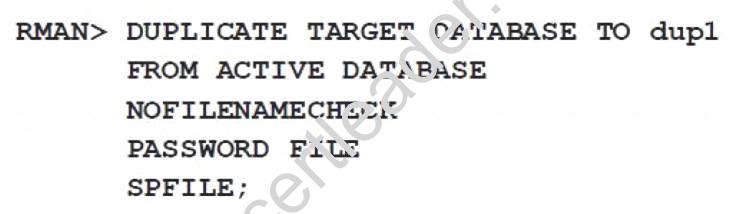
Which two statements are true about the execution of the DUPLICATE command? (Choose two.)
- A. All archive redo log files are automatically copied to the duplicate database.
- B. The duplicate database has the same directory structure as the source database.
- C. The duplicate database is created by using the backups created during the execution of the DUPLICATE command.
- D. The password file and SPFILE for the duplicate database DUP1 are created in their respective default locations.
- E. The duplicate database is created without using RMAN backups and PROD: is allowed to remain open during duplication.
Answer: BE
NEW QUESTION 17
You are administering a multitenant container database (CDB) cdb1. Examine the command and its output:
SQL>show parameterfile NAME TYPE VALUE
-----------------------------------------------------------------------
db_create_file_dest string db_file_name_convert string
db_files integer 200
You verify that sufficient disk space is available and that no file currently exists in the ‘/u0l/app/oracle/oradata/cdb1/salesdb' location.
You plan to create a new pluggable database (PDB) by using the command: SQL>CREATEPLUGGABLEDATABASESALESPDB
ADMINUSER salesadm IDENTIFIED BY password; ROLES=(dba)
DEFAULTTABLESPACE sales
DATAFILE' /u01/app/oracle/oradata/cdb1/salesdb/sales01.dbf’SIZE 250M AUTOEXTEND ON FILE_NAME_CONVERT=(‘/u01/app/oracle/oradata/cdb1/pdbseed/', '/u01/app/oracle/oradata/cdb1/salesdb/')
STORAGE(MAXSIZE2G)
PATK_PREFIX='/u01/app/oracle/oradata/cdb1/SALESPDB'; Which statement is true?
- A. SALESPDB is created and is in mount state.
- B. PDB creation fails because the db_file_name_convert parameter is not set in the CDB.
- C. SALESPDB is created and is in read/write mode.
- D. PDB creation fails because a default temporary tablespace is not defined for SALESPDB.
Answer: A
NEW QUESTION 18
Which two statements are true when row-archival management is enabled? (Choose two.)
- A. Visibility of the ORA_ARCHIVE_STATE column is controlled by the row archival visibility session parameter.
- B. The ORA_ARCHIVE_STATE column is updated manually or by a program that can reference activity tracking columns, to indicate that a row is no longer considered active.
- C. The row archival visibility session parameter defaults to all rows.
- D. The ORA_ARCHIVE_STATE column is visible if it is referenced in the select list of a query.
- E. The ORA_ARCHIVE_STATE column is updated automatically by the database based on activity tracking columns, to indicate that a row is no longer considered active.
Answer: BD
NEW QUESTION 19
When is the UNDO_RETENTION parameter value ignored by a transaction?
- A. when the data file of the undo tablespace is autoextensible
- B. when there are multiple undotablespaces available in a database
- C. when the undo tablespace is of a fixed size and retention guarantee is not enabled
- D. when Flashback Database is enabled
Answer: C
NEW QUESTION 20
Which three requirements should be successfully met by an Oracle Secure Backup (OSB) user so that OSB performs RMAN backup or restore requests? (Choose three.)
- A. RMAN preauthorization on the host
- B. OSB encryption for data in transport and on tape
- C. matching the OS user identity of the Oracle instance associated with the database username
- D. assigned to a class with rights to back up or restore Oracle database
- E. scheduling of the RMAN backup to occur automatically at user-defined intervals
- F. assigned to a class with rights to browse all directories and catalogs
Answer: ADF
Explanation: A: Performing Oracle database backups using RMAN requires RMAN user preauthorization within OSBD: The preauthorized Oracle Secure Backup user must also be assigned to an Oracle Secure Backup class
possessing the following rights:
access Oracle backups (set to owner, class, or all) perform Oracle backups and restores
F: The preauthorized Oracle Secure Backup user must be mapped to operating system privileges to access the files to be backed up or restored. the preauthorized Oracle Secure Backup user can perform RMAN operations only on the host where it has access to files.
References: https://docs.oracle.com/cd/E16926_01/doc.121/e16564/osb_rman_backup.htm#OBADM199
P.S. Easily pass 1Z0-063 Exam with 235 Q&As Surepassexam Dumps & pdf Version, Welcome to Download the Newest Surepassexam 1Z0-063 Dumps: https://www.surepassexam.com/1Z0-063-exam-dumps.html (235 New Questions)