A Review Of Exact 1Z0-062 Practice Question
Examcollection offers free demo for 1Z0-062 exam. "Oracle Database 12c: Installation and Administration", also known as 1Z0-062 exam, is a Oracle Certification. This set of posts, Passing the Oracle 1Z0-062 exam, will help you answer those questions. The 1Z0-062 Questions & Answers covers all the knowledge points of the real exam. 100% real Oracle 1Z0-062 exams and revised by experts!
Free demo questions for Oracle 1Z0-062 Exam Dumps Below:
NEW QUESTION 1
In your database instance, the UNDO_RETENTION parameter is set to 1000 and undo retention is not guaranteed for the fixed size undo tablespace.
Which statement is true about undo retention?
- A. Undo is retained in the UNDO tablespace for 1000 seconds, and then moved to the SYSTEM tablespace to provide read consistency.
- B. Inactive undo is retained for at least 1000 seconds if free undo space is available.
- C. Inactive undo is retained for 1000 seconds even if new transactions fall due to lack of space in the undo tablespace.
- D. Undo becomes expired obsolete after 1000 second
Answer: B
NEW QUESTION 2
You must track all transactions that modify certain tables in the sales schema for at least three years. Automatic undo management is enabled for the database with a retention of one day.
Which two must you do to track the transactions? (Choose two.)
- A. Enable supplemental logging for the database.
- B. Specify undo retention guarantee for the database.
- C. Create a Flashback Data Archive in the tablespace where the tables are stored.
- D. Create a Flashback Data Archive in any suitable tablespace.
- E. Enable Flashback Data Archiving for the tables that require tracking.
Answer: DE
Explanation:
E: By default, flashback archiving is disabled for any table. You can enable flashback archiving for a table if you have the FLASHBACK ARCHIVE object privilege on the Flashback Data Archive that you want to use for that table.
D: Creating a Flashback Data Archive
/ Create a Flashback Data Archive with the CREATEFLASHBACK ARCHIVE statement, specifying the following: Name of the Flashback Data Archive
Name of the first tablespace of the Flashback Data Archive
(Optional) Maximum amount of space that the Flashback Data Archive can use in the first tablespace
/ Create a Flashback Data Archive named fla2 that uses tablespace tbs2, whose data will be retained for two years: CREATEFLASHBACK ARCHIVE fla2 TABLESPACE tbs2 RETENTION 2 YEAR;
NEW QUESTION 3
Which two are true concerning a multitenant container database with three pluggable database? (Choose two.)
- A. All administration tasks must be done to a specific pluggable database.
- B. The pluggable databases increase patching time.
- C. The pluggable databases reduce administration effort.
- D. The pluggable databases are patched together.
- E. Pluggable databases are only used for database consolidatio
Answer: CD
NEW QUESTION 4
You want to capture column group usage and gather extended statistics for better cardinality estimates for the CUSTOMERS table in the SH schema.
Examine the following steps:
1. Issue the SELECT DBMS_STATS.CREATE_EXTENDED_STATS (‘SH’, ‘CUSTOMERS’) FROM dual statement.
2. Execute the DBMS_STATS.SEED_COL_USAGE (null, ‘SH’, 500) procedure.
3. Execute the required queries on the CUSTOMERS table.
4. Issue the SELECT DBMS_STATS.REPORT_COL_USAGE (‘SH’, ‘CUSTOMERS’) FROM dual statement.
Identify the correct sequence of steps.
- A. 3, 2, 1, 4
- B. 2, 3, 4, 1
- C. 4, 1, 3, 2
- D. 3, 2, 4, 1
Answer: B
Explanation:
Step 1 (2). Seed column usage
Oracle must observe a representative workload, in order to determine the appropriate column groups. Using the new procedure DBMS_STATS.SEED_COL_USAGE, you tell Oracle how long it should observe the workload.
Step 2: (3) You don't need to execute all of the queries in your work during this window. You can simply run explain plan for some of your longer running queries to ensure column group information is recorded for these queries.
Step 3. (1) Create the column groups
At this point you can get Oracle to automatically create the column groups for each of the tables based on the usage information captured during the monitoring window. You simply have to call the DBMS_STATS.CREATE_EXTENDED_STATS function for each table.This function requires just two arguments, the schema name and the table name. From then on, statistics will be maintained for each column group whenever statistics are gathered on the table.
Note:
* DBMS_STATS.REPORT_COL_USAGE reports column usage information and records all the SQL operations the database has processed for a given object.
* The Oracle SQL optimizer has always been ignorant of the implied relationships between data columns within the same table. While the optimizer has traditionally analyzed the distribution of values within a column, he does not collect value-based relationships between columns.
* Creating extended statisticsHere are the steps to create extended statistics for related table columns withdbms_stats.created_extended_stats:
1 - The first step is to create column histograms for the related columns.2 – Next, we run dbms_stats.create_extended_stats to relate the columns together.
Unlike a traditional procedure that is invoked via an execute (“exec”) statement, Oracle extended statistics are created via a select statement.
NEW QUESTION 5
Examine the details of the Top 5 Timed Events in the following Automatic Workloads Repository (AWR) report: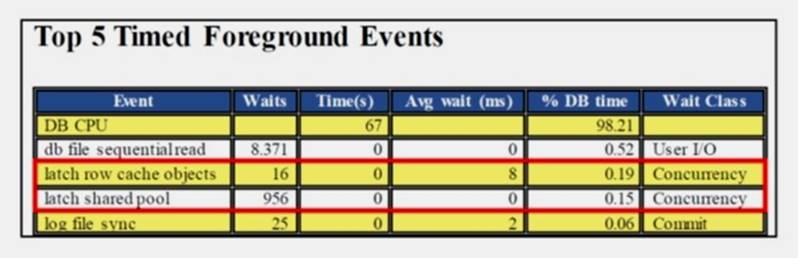
What are three possible causes for the latch-related wait events?
- A. The size of the shared pool is too small.
- B. Cursors are not being shared.
- C. A large number COMMITS are being performed.
- D. There are frequent logons and logoffs.
- E. The buffers are being read into the buffer cache, but some other session is changing the buffer
Answer: ABD
NEW QUESTION 6
Examine this command executed on a client that is remote from the database server. SQL> CONNECT hr/hr@orcl Which two are required for this command to connect the SQLPLUS client to a database instance? (Choose two.)
- A. An orcl TNS entry must be defined in the client-side and server-side tnsnames.ora files
- B. An orcl TNS entry must be defined in the client-side tnsnames.ora file
- C. A service name must be defined to the listener that matches the service name in the orcl TNS entry
- D. An orcl TNS entry must be defined in the server-side tnsnames.ora file
- E. The service name orcl must be defined to the listener
Answer: DE
NEW QUESTION 7
You are connected using SQL* Plus to a multitenant container database (CDB) with SYSDBA privileges and execute the following sequence statements: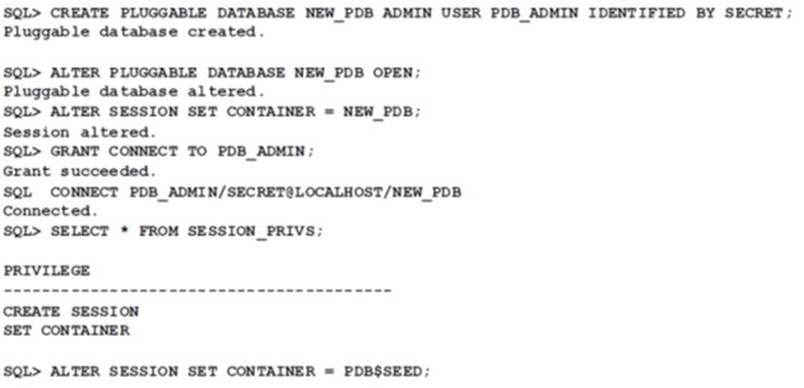
What is the result of the last SET CONTAINER statement and why is it so?
- A. It succeeds because the PDB_ADMIN user has the required privileges.
- B. It fails because common users are unable to use the SET CONTAINER statement.
- C. It fails because local users are unable to use the SET CONTAINER statement.
- D. If fails because the SET CONTAINER statement cannot be used with PDB$SEED as the target pluggable database (PDB).
Answer: C
NEW QUESTION 8
Which three statements are true about Oracle checkpoint processing? (Choose three.)
- A. Frequent thread checkpoints can degrade database performance
- B. Database Writer (DBWn) processes write checkpoint information to datafile headers and the control file
- C. It reduces the recovery time from instance failures
- D. Incremental checkpoints write some dirty buffers to the datafiles and unwritten redo to the online redo logs.
- E. Thread checkpoints ensure that all dirty buffers are written to data files during a normal shutdown
Answer: BCE
NEW QUESTION 9
You support Oracle Database 12c Oracle Database 11g, and Oracle Database log on the same server. All databases of all versions use Automatic Storage Management (ASM).
Which three statements are true about the ASM disk group compatibility attributes that are set for a disk group? (Choose three.)
- A. The ASM compatibility attribute controls the format of the disk group metadata.
- B. RDBMS compatibility together with the database version determines whether a database Instance can mount the ASM disk group.
- C. The RDBMS compatibility setting allows only databases set to the same version as the compatibility value, to mount the ASM disk group.
- D. The ASM compatibility attribute determines some of the ASM features that may be used by the Oracle disk group.
- E. The ADVM compatibility attribute determines the ACFS features that may be used by the Oracle 10 g database.
Answer: ABD
Explanation:
AD: The value for the disk group COMPATIBLE.ASM attribute determines the minimum software version for an Oracle ASM instance that can use the disk group. This setting also affects the format of the data structures for the Oracle ASM metadata on the disk.
B: The value for the disk group COMPATIBLE.RDBMS attribute determines the minimum COMPATIBLE database initialization parameter setting for any database instance that is allowed to use the disk group. Before advancing the COMPATIBLE.RDBMS attribute, ensure that the values for the COMPATIBLE initialization parameter for all of the databases that access the disk group are set to at least the value of the new setting for COMPATIBLE.RDBMS.
For example, if the COMPATIBLE initialization parameters of the databases are set to either 11.1 or 11.2, then COMPATIBLE.RDBMS can be set to any value between 10.1 and 11.1 inclusively.
Not E:
/The value for the disk group COMPATIBLE.ADVM attribute determines whether the disk group can contain Oracle ASM volumes. The value must be set to 11.2 or higher. Before setting this attribute, the COMPATIBLE.ASM value must be 11.2 or higher. Also, the Oracle ADVM volume drivers must be loaded in the supported environment.
/ You can create an Oracle ASM Dynamic Volume Manager (Oracle ADVM) volume in a disk group. The volume device associated with the dynamic volume can then be used to host an Oracle ACFS file system.
The compatibility parameters COMPATIBLE.ASM and COMPATIBLE.ADVM must be set to 11.2 or higher for the disk group.
Note:
* The disk group attributes that determine compatibility are COMPATIBLE.ASM, COMPATIBLE.RDBMS. and COMPATIBLE.ADVM. The COMPATIBLE.ASM and COMPATIBLE.RDBMS attribute settings determine the minimum Oracle Database software version numbers that a system can use for Oracle ASM and the database instance types respectively. For example, if the Oracle ASM compatibility setting is 11.2, and RDBMS compatibility is set to 11.1, then the Oracle ASM software version must be at least 11.2, and the Oracle Database client software version must be at least 11.1. The COMPATIBLE.ADVM attribute determines whether the Oracle ASM Dynamic Volume Manager feature can create an volume in a disk group.
NEW QUESTION 10
When does a database checkpoint occur?
- A. When there is an online redo log switch.
- B. When a user session terminates abnormally.
- C. When a server process terminates abnormally.
- D. When the SHUTDOWN ABORT command is issue
Answer: A
NEW QUESTION 11
Which statement is true about the Oracle central inventory directory (oraInventory)?
- A. oraInventory must not be shared by all Oracle software installations on a single system.
- B. If ORACLE_BASE is set to /u01/app/oracle for the oracle user during an installation, OUI creates the Oracle Inventory directory in the /u01/app/oracle/ oraInventory path.
- C. lf an OFA-compliant path is not created and the ORACLE_BASE environment variable is not set during an Oracle Database installation, the Oracle Inventory directory is placed in the home directory of the user that is performing the installation.
- D. Oracle software owners must be members of the same central oraInventory group, but they need not have this group as their primary group.
Answer: D
Explanation:
References https://docs.oracle.com/database/121/CWLIN/usrgrps.htm#CWLIN483
NEW QUESTION 12
What is the benefit of running the catctl.pl script during an upgrade of a pre-12c database to an Oracle 12c database?
- A. It provides a summary of the upgrade results.
- B. It recompiles all invalid PL/SQL and Java code.
- C. It generates a log file containing the fixes that can be made to the source database.
- D. It provides parallel upgrade options to finish the upgrade process with a reduced down time.
- E. It generates fix-up scripts to be run on the source database before upgrade.
Answer: D
Explanation:
References: https://docs.oracle.com/database/121/UPGRD/upgrade.htm#UPGRD52860
NEW QUESTION 13
Examine the following query output: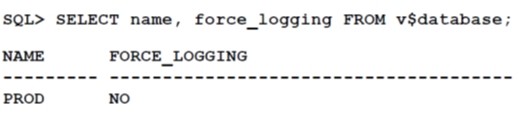
You issue the following command to import tables into the hr schema:
$ > impdp hr/hr directory = dumpdir dumpfile = hr_new.dmp schemas=hr TRANSFORM=DISABLE_ARCHIVE_LOGGING: Y
Which statement is true?
- A. All database operations performed by the impdp command are logged.
- B. Only CREATE INDEX and CREATE TABLE statements generated by the import are logged.
- C. Only CREATE TABLE and ALTER TABLE statements generated by the import are logged.
- D. None of the operations against the master table used by Oracle Data Pump to coordinate its activities are logged.
Answer: C
Explanation:
Oracle Data Pump disable redo logging when loading data into tables and when creating indexes.
The new TRANSFORM option introduced in data pumps import provides the flexibility to turn off the redo generation for the objects during the course of import. The Master Table is used to track the detailed progress information of a Data Pump job.
The Master Table is created in the schema of the current user running the Pump Dump export or import, and it keeps tracks of lots of detailed information.
NEW QUESTION 14
On your Oracle 12c database, you invoked SQL *Loader to load data into the EMPLOYEES table in the HR schema by issuing the following command:
$> sqlldr hr/hr@pdb table=employees
Which two statements are true regarding the command? (Choose two.)
- A. It succeeds with default settings if the EMPLOYEES table belonging to HR is already defined in the database.
- B. It fails because no SQL *Loader data file location is specified.
- C. It fails if the HR user does not have the CREATE ANY DIRECTORY privilege.
- D. It fails because no SQL *Loader control file location is specified.
Answer: AC
Explanation:
Note:
* SQL*Loader is invoked when you specify the sqlldr command and, optionally, parameters that establish session characteristics.
NEW QUESTION 15
Your database is in ARCHIVELOG mode. You want to disable archiving for the database. Examine these steps:
1. Execute the ALTER DATABASE NOARCHIVELOG command
2. Execute SHUTDOWN IMMEDIATE
3. Execute STARTUP MOUNT
4. Set the DB_RECOVERY_FILE_DEST parameter to $ORACLE_HOME/dbs/
5. Execute STARTUP NOMOUNT
6. Open the database
7. Execute SHUTDOWN TRANSACTIONAL
Identify the required steps in the correct sequence.
- A. 1, 2, 3, 4, 6
- B. 2, 5, 1, 6
- C. 4, 2, 5, 1, 6
- D. 2, 3, 1, 6
Answer: B
Explanation:
Reference:
http://dba-oracle.com/bk_disable_archive_log_mode.htm
NEW QUESTION 16
Your database is in NOARCHIVELOG mode. You want to enable archiving for the database. Examine the steps:
1. Execute the ALTER DATABASE ARCHIVELOG command.
2. Execute SHUTDOWN IMMEDIATE.
3. Execute STARTUP MOUNT.
4. Set the DB_RECOVERY_FILE_DEST parameter to $ORACLE_HOME/dbs/.
5. Execute STARTUP NOMOUNT.
6. Open the database.
Identify the required steps in the correct sequence.
- A. 4, 2, 5, 1, 6
- B. 1, 2, 3, 4, 6
- C. 2, 3, 1, 6
- D. 2, 5, 1, 6
Answer: C
NEW QUESTION 17
You are connected to a pluggable database (PDB) as a common user with DBA privileges. The STATISTICS_LEVEL parameter is PDB_MODIFIABLE. You execute the following: SQL > ALTER SYSTEM SET STATISTICS_LEVEL = ALL SID = ‘*’ SCOPE = SPFILE; Which is true about the result of this command?
- A. The STATISTICS_LEVEL parameter is set to all whenever this PDB is re-opened.
- B. The STATISTICS_LEVEL parameter is set to ALL whenever any PDB is reopened.
- C. The STATISTICS_LEVEL parameter is set to all whenever the multitenant container database (CDB) is restarted.
- D. Nothing happens; because there is no SPFILE for each PDB, the statement is ignore
Answer: A
NEW QUESTION 18
Examine the parameter settings in your local ORCL database: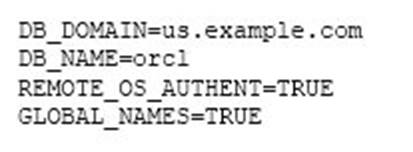
Examine the parameter settings for the remote SALES database: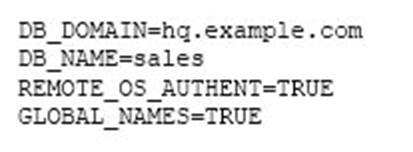
As the SYS user, you issue the following command on ORCL:
CREATE PUBLICDATABASE LINK sales.us.example.com USING ‘sales1’; The sales1 tnsnames entry points to the sales database instance.
Which two are requirements to ensure that you can successfully connect by using this database link? (Choose two.)
- A. The GLOBAL_NAMES initialization parameter should be set to FALSE in the ORCL database.
- B. The SALES1 net service name should be known to both the local and remote databases.
- C. Local database users who use this database link should have accounts and the required privileges in the remote database.
- D. The REMOTE_OS_AUTHENT initialization parameter should be set to FALSE in the remote database.
- E. Only the user creating the database link must have an account and the required privileges in the remote databas
Answer: AC
NEW QUESTION 19
Your database instance has started using an SPFILE. Examine the RMAN configuration settings:
You execute the command:
RMAN> BACKUP AS COPY TABLESPACE TEST;
Which three types of files are backed up by using this command? (Choose three.)
- A. online redo log files
- B. control file
- C. SPFILE
- D. archived redo log files
- E. data file(s)
- F. PFILE
Answer: BCE
Explanation:
References:
http://www.juliandyke.com/Research/RMAN/BackupCommand.php
NEW QUESTION 20
Which four are true about creating and running a remote database scheduler jobs? (Choose four.)
- A. A database destination must exist or be created for the remote database
- B. It must run as a user that is defined on the remote database
- C. Remote database jobs always run as the same user who submits the job on the local database
- D. A credential is optional for a remote database job
- E. A credential must be created to define the remote user
- F. A database destination group must exist or be created for a job to run on multiple remote databases
- G. A destination is optional for a remote database job because DB links can be used instead
Answer: ABDF
NEW QUESTION 21
Examine this command:
SQL> ALTER SYSTEM SET ENABLE_DDL_LOGGING=TRUE;
Which two statements are true? (Choose two.)
- A. All data definition language (DDL) statements are written to the control file
- B. Some DDL statements are written to an XML file in the ADR home
- C. All DDL statements are logged in to a text file in Automatic Diagnostic Repository (ADR) home
- D. Some data definition language (DDL) statements are written to the control file
- E. Some DDL statements are written to a text file in the ADR home
- F. The Alert Log still contains some DDL statements
Answer: DE
NEW QUESTION 22
You want execution of large database operations to suspend, and then resume, in the event of space allocation failures. You set the value of the initialization parameter RESUMABLE_TIMEOUT to 3600. Which two statements are true? (Choose two.)
- A. Before a statement executes in resumable mode, the ALTER SESSION ENABLE RESUMABLE statement must be issued in its session.
- B. Data Manipulation Language (DML) operations are resumable, provided that they are not embedded in a PL/SQL block.
- C. A resumable statement can be suspended and resumed only once during execution.
- D. A suspended statement will report an error if no corrective action has taken place during a timeout period.
- E. Suspending a statement automatically results in suspending a transaction and releasing all the resources held by the transaction.
Answer: AD
NEW QUESTION 23
Which users are created and can be used for database and host management of your DBaaS database servers?
- A. opc and oracle users
- B. root, oracle and cloud users
- C. root and oracle users
- D. root, opc and oracle users
- E. cloud and oracle users
Answer: A
NEW QUESTION 24
Your database is configured in ARCHIVELOG mode, and a daily full database backup is taken by using RMAN. Control file autobackup is configured.
Loss of which three database files can lead to an incomplete recovery? (Choose three.)
- A. inactive online redo log file group
- B. a data file belonging to the default temporary tablespace
- C. a data file belonging to the SYSAUX tablespace
- D. server parameter le (SPFILE)
- E. active online redo log le group
- F. all the control flies
Answer: AEF
NEW QUESTION 25
What is a requirement for creating a remote database scheduler job?
- A. The remote database job must run as a user that is valid on the target remote database.
- B. A private database link must be created from the originating database to the target remote database.
- C. The target remote database on which the job is scheduled must be Oracle Database 11g Release 2 or later.
- D. The target remote database must be on a different host form the originating scheduler database hos
Answer: A
NEW QUESTION 26
Which three statements are true regarding the use of the Database Migration Assistant for Unicode (DMU)? (Choose three.)
- A. ADBA can check specific tables with the DMU
- B. The database to be migrated must be opened read-only.
- C. The release of the database to be converted can be any release since 9.2.0.8.
- D. The DMU can report columns that are too long in the converted characterset.
- E. The DMU can report columns that are not represented in the converted characterset.
Answer: ADE
Explanation:
A: In certain situations, you may want to exclude selected columns or tables from scanning or conversion steps of the migration process.
D: Exceed column limit
The cell data will not fit into a column after conversion. E: Need conversion
The cell data needs to be converted, because its binary representation in the target character set is different than the representation in the current character set, but neither length limit issues nor invalid representation issues have been found
* Oracle Database Migration Assistant for Unicode (DMU) is a unique next-generation migration tool providing an end- to-end solution for migrating your databases from legacy encodings to Unicode.
Incorrect:
Not C: The release of Oracle Database must be 10.2.0.4, 10.2.0.5, 11.1.0.7, 11.2.0.1, or later.
NEW QUESTION 27
Your database is open and the LISTENER listener running. You stopped the wrong listener LISTENER by issuing the following command:
1snrctl > STOP
What happens to the sessions that are presently connected to the database Instance?
- A. They are able to perform only queries.
- B. They are not affected and continue to function normally.
- C. They are terminated and the active transactions are rolled back.
- D. They are not allowed to perform any operations until the listener LISTENER is started.
Answer: B
Explanation:
The listener is used when the connection is established. The immediate impact of stopping the listener will be that no new session can be established from a remote host. Existing sessions are not compromised.
NEW QUESTION 28
You plan to install the Oracle Database 12c software on a new server. The database will use Automatic Storage Management (ASM) and Oracle Restart. Oracle Grid Infrastructure for a standalone server is already installed on the server.
You want to configure job role separation. You create the following operating system users and groups:
- The user oracle as the owner of the Oracle database installation
- The user grid as the owner of Oracle Grid Infrastructure
- The group oinstall as an Oracle Inventory group
- The group dba as the OSDBA group for Oracle database
- The group asmdba as the OSDBA group for Oracle ASM
- The group asmadmin as the administration privileges group for Oracle ASM
- The group asmoper as the group for Oracle ASM
Which two additional tasks should you perform with regard to the OS-level owners and groups? (Choose two.)
- A. creating a separate central inventory group for the Oracle Database 12c installation
- B. assigning oinstall as the primary group for the oracle user
- C. assigning asmadmin and asmoper as primary groups for the oracle user
- D. creating OS groups associated with the OSBACKUPDBA, OSDGDBA, and OSKMDBA system privileges
- E. assigning asmdba as the secondary group for the oracle user
Answer: BD
NEW QUESTION 29
......
Recommend!! Get the Full 1Z0-062 dumps in VCE and PDF From Dumps-files.com, Welcome to Download: https://www.dumps-files.com/files/1Z0-062/ (New 362 Q&As Version)